Kagutsuchi-no-Kami: The Fire God Humanity Learned to Live With
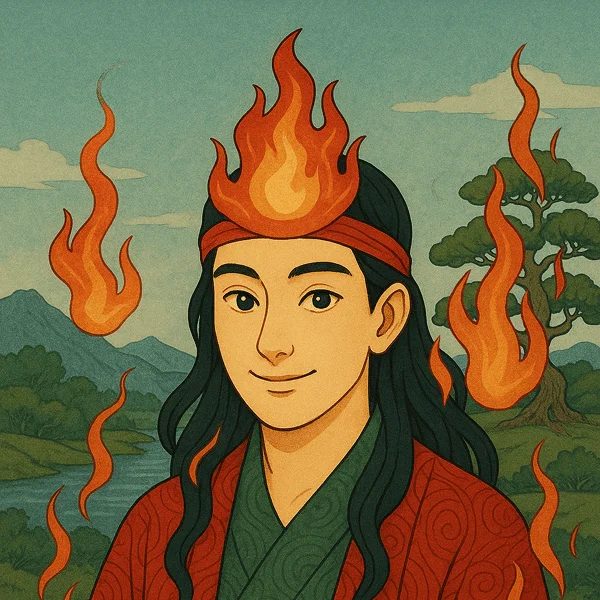
Who Is Kagutsuchi-no-Kami—And What Does Fire Represent in Japanese Mythology?
Kagutsuchi-no-Kami is not simply the god of fire, but a presence that embodies a force too powerful to remain whole.
He appears as:
- a destructive power whose birth brings both creation and loss
- a force that must be divided and transformed to preserve balance
- and a presence that continues to exist in controlled forms within human life
In this article, we will gently explore:
- who Kagutsuchi is and why he was cut down
- what his division reveals about overwhelming natural forces
- and how fire came to be understood as something to live with rather than overcome
Do you know the Japanese god of fire who was killed almost at the moment of his birth?
That god is Kagutsuchi-no-Kami.
His birth took the life of his mother, Izanami-no-Mikoto, and soon after, his father Izanagi-no-Mikoto is said to have struck him down with a sword.
Yet this tragic episode raises a quiet but profound question.
Did Izanagi truly kill Kagutsuchi out of grief alone?
And in a world where the concept of “death” had not yet fully taken shape, can Kagutsuchi’s fate truly be understood as death?
Let us begin a journey into the myth of Kagutsuchi, and explore how ancient people understood overwhelming natural forces and wove them into the order of the world.
Who is Kagutsuchi-no-Kami?
Before exploring the myths surrounding him, let us first take a brief look at the basic profile of Kagutsuchi-no-Kami.
Basic Profile
Kagutsuchi is the god of fire in Japanese mythology.
He is known as the final deity born to the creator goddess Izanami-no-Mikoto.
| Aspect | Description |
|---|---|
| Name | Ho-no-Kagutsuchi-no-Kami (火之迦具土神) |
| Domain | Fire |
| Parents | Izanagi-no-Mikoto and Izanami-no-Mikoto |
| Mythological Role | Embodiment of overwhelming fire |
| Mythological Sources | Kojiki and Nihon Shoki |
| Fate | Cut down by Izanagi shortly after his birth |
Names in Ancient Texts
Kagutsuchi appears in the stories under several different names.
To understand him more clearly, let us see how he is named in the Kojiki and the Nihon Shoki.
Names in the Kojiki (Records of Ancient Matters)
In the Kojiki, Kagutsuchi is recorded under the following names:
-
Ho-no-Yagihayao-no-Kami (火之夜藝速男神)
- Yagi conveys the act of burning or scorching
- Haya means swift or rapid → Together, the name evokes fire that spreads quickly and consumes all around it
-
Ho-no-Kagabiko-no-Kami (火之炫毘古神)
- Kaga suggests brightness or shining flames, often associated with torchlight or bonfires → This name emphasizes the dazzling, radiant aspect of fire
-
Ho-no-Kagutsuchi-no-Kami (火之迦具土神)
- Kagu describes the flickering or blazing appearance of fire → This form became the most commonly used name in later tradition
Names in the Nihon Shoki (Chronicles of Japan)
In the Nihon Shoki, the fire god appears under a slightly different set of names:
-
Kagutsuchi (軻遇突智)
- A phonetic rendering that emphasizes the sound and force of fire
-
Homusubi (火産霊)
- Literally “the spirit that gives birth through fire” → This name highlights fire as a generative, creative power rather than mere destruction
These names reflect how fire was understood by people of the time.
To them, fire was a force that could destroy in an instant, yet one that also brought life, creation, and transformation.
Defining Characteristics
Kagutsuchi’s most striking characteristic is the lasting impact of his presence, despite the fact that he speaks no words and performs no great deeds.
His story unfolds within an extremely brief span of time—from his birth from Izanami to the moment he is struck down by Izanagi’s sword.
Yet this very brevity reveals something essential.
It shows how profoundly important fire was to ancient people, and at the same time, how deeply it was feared.
Fire was indispensable to life, yet too dangerous to remain unchecked.
In this sense, the overwhelming power of Kagutsuchi is not measured by actions or achievements, but by the magnitude of the force he embodied.
Mythological Episode: Why Was Kagutsuchi Cut Down?
Now that we have learned the basics of Kagutsuchi, let us explore the questions his myth leaves behind—and look more deeply into what they may mean.
A Tragic Act at First Glance
The birth of Kagutsuchi inflicted fatal burns upon his mother, Izanami.
Despite Izanagi’s prayers, her wounds could not be healed, and she soon passed away.
Overcome by grief and anger, Izanagi drew the Totsuka Sword and struck down Kagutsuchi.
At first glance, this episode appears to be a deeply emotional tragedy—a story of a husband who lost his beloved wife, and of a father who, consumed by sorrow and rage, took revenge upon his own child.
However, if we look at this scene through the lens of order and disruption in Japanese mythology, a different perspective begins to emerge.
To explore why Kagutsuchi was cut down, let us compare his fate with that of other gods.
Why Was Kagutsuchi Treated Differently?
In Japanese mythology, maintaining the order and balance of the world is a fundamental theme.
Gods who are judged to have disrupted this order are expected to face consequences.
For example, Susanoo-no-Mikoto refused the role assigned to him at birth and rejected the responsibilities expected of him as a god.
Even so, his father Izanagi did not cut him down as he did Kagutsuchi.
The punishment imposed on Susanoo was not destruction, but exile.
This choice left open the possibility of return—a chance for transformation and redemption.
When viewed alongside Susanoo’s fate, the severity of Kagutsuchi’s destiny becomes strikingly clear.
Kagutsuchi was cut down by Izanagi and given no second chance, no room for redemption.
Here, an unavoidable question emerges.
What distinguished Kagutsuchi from Susanoo, even though both were sons of Izanagi?
Why was one exiled, while the other was brought to such a final end?
Division Rather Than Death
In fact, when Kagutsuchi was cut down by Izanagi’s sword, it did not necessarily signify a simple or final death.
The fire he embodied was overwhelming—powerful enough to destroy even a god.
Izanagi judged that such force could not be left intact within the world.
By striking Kagutsuchi with his sword, he chose to divide that power and disperse it into separate elements.
In this interpretation, the act was not meant to erase Kagutsuchi from existence, but to prevent excessive power from disrupting the order of the mythic world.
Certainly, Izanagi must have felt grief and anger.
Yet his decision was not driven by emotion alone.
Rather, it can be understood as a judgment made in his role as a creator god—a choice to restrain what threatened cosmic balance and to preserve harmony within the world.
In this sense, Kagutsuchi’s fate reflects not a punishment, but a moment in which overwhelming power was divided so that the world itself could continue to endure.
Before the Boundary Between Life and Death
There is one more perspective from which Kagutsuchi’s fate can be considered.
At the point in the myth where his story unfolds, the boundary between life and death had not yet been clearly defined.
In Japanese mythology, the concept of “death” itself only becomes fully articulated later, after Izanami descends into Yomi following her passing.
In this sense, it is possible to understand that Kagutsuchi did not truly meet “death” after he was cut down.
He disappears from the narrative, but his power does not vanish.
Instead, that power is divided, dispersed, and carried on in other forms.
The force he embodied continues to exist—transformed, redistributed, and woven into the world.
From Division to Creation: The Gods Born from Kagutsuchi
Kagutsuchi was cut down not simply to end his existence, but to divide the power he embodied.
What kinds of forces emerged from that division?
In this section, we will explore the deities born from Kagutsuchi and examine how ancient people understood and came to live alongside the power of fire.
The Release of Kagutsuchi’s Power
When Kagutsuchi was cut down, new deities deeply connected to fire came into existence.
Drawing on the Kojiki, we will explore the gods born through the act of cutting Kagutsuchi with the Totsuka Sword—both those arising from the sword and those born from Kagutsuchi himself.
Fire and Metal—The Sword Gods
From the tip and blade of the sword, gods associated with swords and iron were born.
This reflects the role of fire in forging metal—a controlled flame that gives shape to tools and weapons.
Here, fire is not destructive, but productive, transforming raw material into something usable.
Fire and Thunder—The Storm Gods
From blood scattered along the blade emerged gods of thunder and lightning.
Thunder was often seen as fire descending from the sky, accompanied by sound, light, and violence.
This connection reveals fire as a heavenly and uncontrollable force, much like lightning or volcanic eruption.
Fire and Water—The Water Gods
From blood falling from the sword’s hilt were born gods of water.
At first glance this may seem contradictory, yet water was essential to controlling fire—cooling metal, extinguishing flames, and restoring balance.
Fire and water were understood not as opposites, but as forces that regulate one another.
Fire and the Land—The Mountain Gods
From Kagutsuchi’s body itself were born many mountain deities.
Mountains were seen as places where fire sleeps within the earth—volcanoes, mineral veins, and the source of stone and metal.
In this way, fire was believed to remain alive within the land, even when unseen.
The Dual Nature of Fire
When we look at the gods born from Kagutsuchi, a clear pattern begins to emerge.
Some are associated with natural fire—lightning, volcanoes, and the forces of the land.
Others are tied to cultural fire—metal, weapons, and the tools shaped by human hands.
For ancient people, fire was never a neutral presence.
Uncontrolled flames could reduce homes and forests to ash, posing a constant threat to survival.
Yet the same fire made cooking possible, hardened clay, forged metal, and allowed tools and weapons to be created.
Fire was always close at hand, carrying both fear and blessing.
The myth of Kagutsuchi reflects this lived reality.
Kagutsuchi himself embodies the terrifying aspect of fire—an overwhelming force beyond human control.
His division, however, represents a turning point:
the moment when fire became something that could be managed, shared, and woven into daily life and culture.
Seen in this way, Kagutsuchi does not vanish from the world.
He continues to walk alongside humanity as a distributed power—a force transformed from a single, fearsome presence into many forms that sustain human life.
Shrine Worship: Akihasan Hongū Akiba Jinja
Even today, Kagutsuchi is enshrined at shrines across Japan, where he is revered with both awe and deep respect.
In this section, we focus on Akihasan Hongū Akiba Jinja—a place where the presence of Kagutsuchi can still be encountered in the modern world.
Kagutsuchi and Mount Akiba
Located in Shizuoka Prefecture, Akihasan Hongū Akiba Jinja is regarded as the head shrine of Akiba worship, where Kagutsuchi is revered as the principal deity.
Kagutsuchi is believed to dwell in the sacred Mount Akiba, which rises behind the shrine.
Here, the power of fire has long been understood not merely as destructive flame, but as light and heat—forms of energy that expanded human activity, supported daily life, and contributed to the development of civilization and industry.
Fire Rituals Passed Down Through the Ages
Each year on December 15th and 16th, the shrine holds its renowned Fire Festival (Hi-matsuri).
During this event, ancient ritual performances known as the Bow Dance, Sword Dance, and Fire Dance are performed—sacred rites said to have been passed down for over 1,300 years.
These rituals express reverence toward fire not as chaos, but as a power that must be honored, controlled, and entrusted to the divine.
Protection from Fire and Everyday Faith
Akiba Shrine is widely worshipped for protection against fire, household safety, commercial prosperity, and the development of industry.
Many worshippers come from local communities praying for fire prevention, as well as firefighters and people whose professions involve working with fire.
In the surrounding regions, it is also customary to visit the shrine when constructing or renovating buildings.
Through a ritual known as kasai chingo (fire protection), worshippers receive a talisman or ridge tag, seeking protection from fire for their homes and workplaces.
For readers who wish to learn more, the official website of Akihasan Hongū Akiba Jinja offers detailed information (Japanese only):
Akihasan Hongū Akiba Jinja
A small break — a little side note
Akihasan Hongū Akiba Jinja: A Golden Torii at the End of the Mountain Road
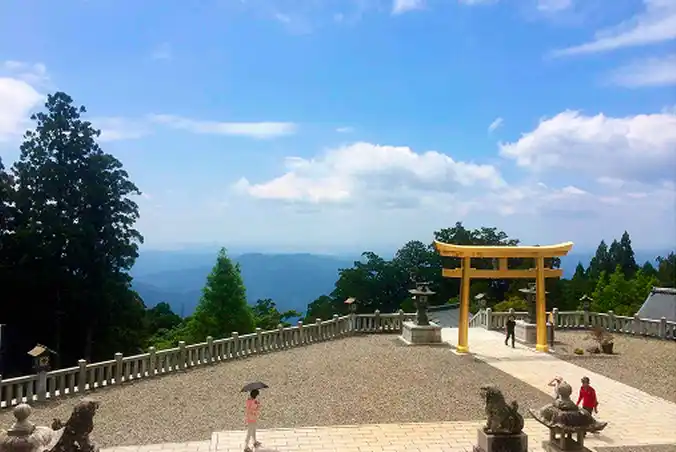
This photograph was taken when I visited Akihasan Hongū Akiba Jinja in person.
At the time, I must admit, I did not even know that this shrine was dedicated to Kagutsuchi.
What drew me there was simple curiosity — the idea of a shrine hidden deep in the mountains.
The road leading up to the shrine stretched for more than 10 kilometers, winding through the forest.
It was so narrow that passing another car felt almost impossible in places, and the journey itself felt like a quiet test of patience and focus.
When I finally arrived, the sight that surprised me most was the golden torii gate.
I had never seen a torii painted in such a color before, and its presence felt both unusual and solemn.
Later, I learned that this golden torii was erected to commemorate the engagement of the current Emperor — a rare and highly symbolic structure, carrying a sense of dignity and celebration.
Standing there, surrounded by mountains and silence, the shrine felt deeply formal and quietly powerful.
Only much later did I realize that I had unknowingly stepped into a place connected to Kagutsuchi — a god whose presence, much like fire itself, reveals its meaning only after we take the time to learn and reflect.
Cultural Legacy: Fire in Craft, Story, and Ritual
Kagutsuchi’s fire influenced many aspects of Japanese culture, long after the age of myth had passed.
Let us explore how his power took root in cultural practices and traditions, and how it came to be expressed through human hands and imagination.
Swordsmiths and Metalworking
In Japan, fire has always stood at the heart of craftsmanship.
For blacksmiths and swordsmiths, flame was not merely a practical tool, but a sacred force that joined flame and iron, transforming raw ore into blades of beauty and power.
The roaring fire of the forge was seen as something more than heat alone.
It was a controlled manifestation of divine power—a form of fire no longer overwhelming, but guided, restrained, and shaped through skill and ritual.
In this way, Kagutsuchi came to be understood as a spiritual presence behind the forge.
His power, once too great to remain whole, lived on in the refined fire that gave birth to Japanese sword-making, a craft that defined much of Japan’s warrior culture.
Literature and Folklore
Kagutsuchi’s legacy also echoes through literature and folklore.
Stories of tragedy, destruction, and renewal associated with fire appear repeatedly in oral traditions across Japan.
Tales such as the Fire Spirit Orb (Hi-dama), the figure of Hi-otoko (the Fire Man)—later linked to the comical mask Hyottoko—and legends of fire gods descending from heaven to burn houses all reflect a worldview in which fire was understood as something alive and willful.
These stories were not meant to inspire fear alone.
They served as quiet lessons—reminding people to handle fire with care, to respect the hearth, and to recognize fire as a divine force that demanded both caution and reverence.
Festivals and Rituals of Fire
Across Japan, fire continues to play a central role in ritual life.
From fire festivals (hi-matsuri) and bonfires (otaki-bi), to fire-walking ceremonies (hiwatari) and the great Okuribi fires of Kyoto, these traditions preserve an ancient reverence for flame.
Through ritual, fire is not rejected or suppressed, but approached, honored, and purified.
Standing close to flame becomes an act of trust—a way of acknowledging both its danger and its blessing.
These practices remain living proof that fire has long been regarded in Japan not merely as a tool, but as a sacred presence woven into the rhythm of life.
A small break — a little side note
Sending Spirits Home with Fire — Kyoto’s Okuribi
Kyoto’s Okuribi is a traditional summer ritual held to guide ancestral spirits back to the Pure Land, after they have been welcomed home during the Obon season.
Though rooted in Buddhist practice, this custom reflects something deeply shared in Japanese culture: the belief that fire allows people to sense and connect with precious, unseen beings.
Fire is not used here to dominate or destroy, but to accompany — to illuminate a path, offer respect, and quietly mark a moment of farewell.
Even in the modern world, Okuribi reminds us that people continue to live alongside the power of fire, feeling both its strength and its gentle presence.
Ultimately, Kagutsuchi endures as a symbol of fire that humans learned to live alongside.
In Japanese culture, he conveys that fire is not merely an object of fear or destruction, but a power that, when respected and carefully guided, can support daily life, creation, and growth.
Conclusion: Living with Fire
The story of Kagutsuchi is often remembered as a tragedy—the tale of a god born only to be cut down.
Yet, as we have seen, his fate was not merely one of destruction.
What was divided was not Kagutsuchi’s existence itself, but the overwhelming power of fire that he embodied.
Through that division, fire was transformed—guided, shared, and woven into human life.
That transformation continues to live on within Japanese culture.
Fire appears in craftsmanship, ritual, and everyday practice—not as an uncontrollable force, but as one that can be approached with care and respect.
Kagutsuchi endures as a symbol of the fire that humans learned to live alongside.
He represents a power that inspires awe and caution, yet also supports creation, growth, and continuity.
Through his story, we come to understand how people learned to stand beside fire—not as its master, but as its mindful companion.
In this way, Kagutsuchi still speaks quietly to us, as a presence to be respected, guided, and lived with.