Izanami-no-Mikoto: The Goddess of Creation, Loss, and the Human Heart
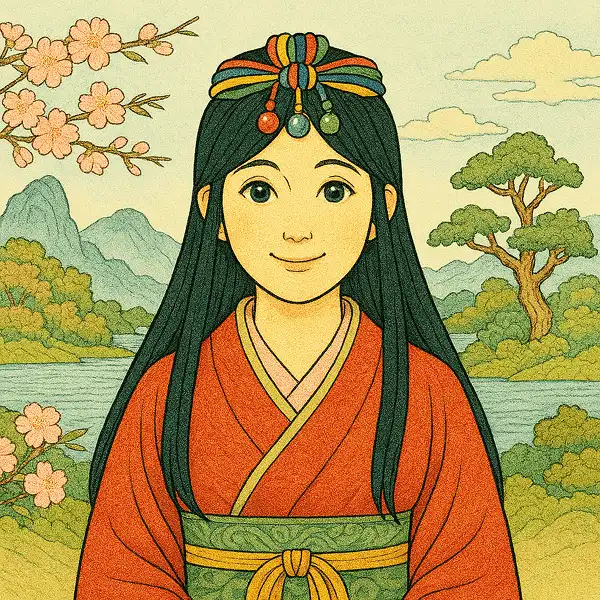
Who Is Izanami-no-Mikoto—And What Did Her Story Set in Motion?
Izanami-no-Mikoto is not simply a creator goddess who gave birth to the land and the gods, but a presence whose actions shaped the irreversible structure of the world.
She appears as:
- a nurturing mother who brings life and the foundations of civilization into existence
- a goddess whose death marks the beginning of separation between life and the underworld
- and a presence whose words give permanence to the cycle of life and death
In this article, we will gently explore:
- who Izanami-no-Mikoto is and her role in the creation of the world
- why her death and transformation into a deity of Yomi carry deeper meaning
- and how her story reveals the cost of creation and the boundaries that define human existence
Do you know the name of the goddess who knew both creation and loss—the one who gave birth to the world, and who also faced death itself?
She is Izanami-no-Mikoto—one of the oldest deities in Japanese mythology, and the mother of the land and the gods.
What kind of existence did Izanami live as a goddess?
And what happens when even a god encounters death?
Let us set out together on a journey to learn about this primordial goddess.
A quiet exploration of how she lived, and how her actions came to shape the world that followed.
Who is Izanami-no-Mikoto?
Before exploring the deeper meaning behind Izanami-no-Mikoto, let us first take a moment to understand who she is as a goddess.
A Simple Profile of Izanami-no-Mikoto
Izanami-no-Mikoto is one of the earliest deities in Japanese mythology.
She belongs to the final generation of the Seven Generations of the Age of the Gods, a divine era that existed before the land of Japan was fully formed.
Born together with her counterpart, Izanagi-no-Mikoto, Izanami took part in the earliest acts that brought the world into form.
Together, they created the land and gave birth to many gods who embody nature and fundamental forces.
To better understand her role, here is a brief overview of Izanami-no-Mikoto:
| Category | Details |
|---|---|
| Divine Role | Primordial creator goddess |
| Era | Seven Generations of the Age of the Gods (final generation) |
| Divine Partner | Izanagi-no-Mikoto |
| Offspring | The Japanese islands and numerous deities |
| Key Domains | Creation, motherhood, death, boundaries |
| Distinctive Trait | A creator goddess who also experiences death |
The Other Names and Dual Nature of Izanami-no-Mikoto
Izanami is also known by other names, such as Yomotsu-Ōkami and Michishiki-no-Ōkami, which identify her as a deity associated with the realm of the dead after her passing.
These names reflect her transformation after death into a sacred presence standing at the boundary between the world of the living and the world of the dead.
As a result, Izanami is remembered as a goddess who embodies two contrasting aspects:
- A nurturing mother, connected to creation, life, and love
- A guardian of death, who protects an impassable boundary
The coexistence of creation and loss is what makes Izanami one of the most complex and compelling figures in Japanese mythology.
Mythological Episodes: Why Did Izanami Have to Die?
Now that we understand who Izanami-no-Mikoto was, one question may naturally arise:
Why did Izanami have to die?
In this section, we will explore this question through the myth itself, and consider why her death was a meaningful part of the story.
Scene from the Myth: The Birth of Fire and Izanami’s Death
In Japanese mythology, Izanami is gravely injured while giving birth to the fire god Kagutsuchi-no-Mikoto.
As she lies wounded, the final deities are born from her body:
- gods of metal,
- gods of clay and soil,
- a goddess of water,
- and gods of crops and nourishment.
These gods represent the last acts of creation performed by Izanami.
The severe burns she suffers prove to be fatal.
She does not recover from her injuries, and her life as a creator goddess comes to an end.
This moment marks the death of Izanami.
What Was This Scene Meant to Express?
From here, let us consider what this episode is meant to convey.
To understand the meaning of Izanami’s death, we must first look more closely at the birth of Kagutsuchi.
Kagutsuchi is the god of fire—and his birth symbolizes the moment when fire enters human life.
With the arrival of fire, human existence is fundamentally transformed.
People learn to:
- clear land for agriculture using fire,
- create pottery by shaping clay and hardening it with fire and water,
- forge tools and weapons through metalworking.
In this sense, the birth of Kagutsuchi represents the beginning of human civilization itself.
The gods born from Izanami as she suffers from her burns are not random.
They embody the essential elements that develop alongside fire—metal, soil, water, and crops—all indispensable to human life and cultural growth.
Seen this way, Izanami’s final acts of creation reflect the foundations of civilization emerging at the very moment fire enters the world.
The Death of the Mother Goddess and the Cost of Progress
Now, let us turn to what Izanami’s death is ultimately meant to convey.
When humanity gained fire, life became richer and civilization began to flourish.
But this transformation did not bring only positive outcomes.
It also marked the beginning of environmental destruction as an unavoidable cost.
In order to survive and advance, humans cut down forests, expanded settlements, and reshaped the landscape.
These acts gradually altered the once abundant world that Izanami herself had created.
The myth expresses this irreversible change through a powerful image—the death of the creator goddess.
Ancient people understood this truth.
They recognized that human progress, born from fire, also meant harming the nurturing natural world that sustained life.
To ensure that this guilt and awareness would not be forgotten, the myth engraved it into its story.
The death of Izanami becomes a symbolic reminder—that civilization is built not only through creation, but also through sacrifice.
Mythological Episodes II: Why Did Izanami Become the Goddess of Yomi?
Let us now consider another question surrounding Izanami.
Why is she remembered as a goddess of Yomi?
In this section, we will explore how Izanami came to be associated with the land of the dead, and how her words and actions within the myth led her to take on this role.
Scene from the Myth: Izanami at Yomi
After her death, Izanami comes to dwell in Yomi, the land of the dead.
Her husband, Izanagi, travels to Yomi in an attempt to bring her back to the world of the living.
The two meet, but Izanami tells him that she cannot return immediately.
She asks him to wait while she seeks permission, and strictly forbids him to look at her.
Unable to endure the wait, Izanagi breaks his promise and looks upon Izanami’s form.
Furious at this betrayal, Izanami declares that she will bring about the death of one thousand people each day.
In response, Izanagi vows that one thousand five hundred people will be born each day.
A great stone is placed between them, sealing the path between the world of the living and the land of the dead.
At that moment, the boundary between life and death is closed, and the cycle of human life and death becomes fixed within the structure of the world.
How Izanami Became the Goddess of Yomi
Izanami did not become the goddess of Yomi simply because she died.
Her role as a deity of the underworld was shaped by what she said and did after her death.
Her declaration that she would bring about the death of one thousand people each day was not spoken with the intention of ruling over death.
It was born from raw emotion—sorrow at betrayal, anger at humiliation, and the pain of love shattered beyond repair.
Yet her words carried an unexpected weight.
By speaking of death while dwelling in the land of the dead, Izanami unintentionally defined death as an inevitable and unchanging part of human existence.
In that moment, death ceased to be an accident or an anomaly, and became a fixed law of the world.
Izanami did not wish to rule Yomi, nor did she choose this role for herself.
However, by giving death a voice—even unintentionally—she gave it meaning, form, and permanence.
From that moment on, Izanami came to stand as the one who defines the boundary between the world of the living and the realm of the dead.
Thus, she became the goddess of Yomi—not by intention, but by the consequences of her words.
Shrines and Worship
Unlike many deities who are widely celebrated across Japan, Izanami is remembered and revered in a quieter and more restrained way.
Here, we will look at several places where her presence can still be felt today.
Yomotsu Hirasaka—The Boundary Between Worlds
Yomotsu Hirasaka, located in Shimane Prefecture, is remembered in mythology as the boundary between the land of the living and the realm of the dead.
According to myth, this is where Izanami and Izanagi face one another for the final time.
Their last exchange of words takes place here, and Izanami becomes the goddess of Yomi, unable to return to the living world.
Through this exchange, the boundary between life and death is spoken into permanence.
The massive stone said to have been placed by Izanagi remains today, symbolizing the irreversible divide between life and death.
The site is approached not as a place to seek blessings, but as a quiet reminder of cosmic order.
Further details can be found on the official Shimane Prefecture tourism website:
Yomotsu Hirasaka
Mount Hiba and the Tomb of Izanami
According to the Kojiki, Izanami passed away in the land of Izumo and was laid to rest on Mount Hiba, in present-day Yasugi City, Shimane Prefecture.
At the mountain’s summit stands Hibayama Kume Shrine, a small shrine that preserves the tradition of Izanami’s burial.
Here, Izanami is remembered not as a ruler of death, but as a goddess whose role had already been fulfilled.
The shrine is also visited by worshippers seeking blessings for safe childbirth, reflecting Izanami’s enduring connection to motherhood and life.
More information is available through the Yasugi City Tourism Guide:
Hibayama Kume Shrine
Hana no Iwaya Shrine—The Goddess as Earth Itself
Another important site associated with Izanami is Hana no Iwaya Shrine in Mie Prefecture.
According to the Nihon Shoki, Izanami died after giving birth to the fire god Kagutsuchi and was buried at Hana no Iwaya.
At this site stands a massive natural rock cave known as Iwaya, long venerated with seasonal flowers.
Rather than a shrine building, the rock itself is worshipped as Izanami’s sacred body and burial place.
Hana no Iwaya is known as one of the oldest shrines in Japan and is part of a UNESCO World Heritage Site.
Twice each year, the Great Sacred Rope Ceremony (Ōtsuna-gake Shinji) is performed, renewing the massive shimenawa that encircles the rock — a ritual that expresses enduring reverence for the goddess and the land.
For more information, see the official Hana no Iwaya website (Japanese only):
Hana no Iwaya Shrine
A small break — a little side note
What kind of place is Hana no Iwaya Shrine, where a single rock is worshipped as a goddess?
This video invites you to quietly explore Hana no Iwaya Shrine. The immense rock standing before you recalls Izanami, the creator goddess of nature.
Cherished by local people since ancient times, the shrine remains deeply alive today. Take a moment to see Izanami resting peacefully, one with the earth itself.
Izanami in Modern Popular Culture
Izanami is not a figure who belongs only to the world of ancient mythology.
She also appears in modern popular culture, where her role is reinterpreted through contemporary themes.
In this section, we will look at a modern portrayal of Izanami through the video game Persona 4.
(The following discussion focuses on symbolism and themes, rather than story details or plot resolution.)
Izanami in the Persona Series
In Persona 4, Izanami is portrayed not as a traditional villain, but as a presence tied to the inner emotions of humanity.
She does not command, judge, or destroy the world directly.
Instead, she allows human emotions—fear, denial, and hope—to take shape and define the reality people come to inhabit.
When people choose comfort over truth, that choice gives rise to a world built on illusion.
When painful realities are avoided, they return in altered forms.
Izanami does not act out of malice.
By refraining from judgment, she allows people to face the consequences of the worlds they themselves have chosen.
A Modern Reflection of an Ancient Goddess
The portrayal of Izanami in Persona 4 closely echoes her role in ancient mythology.
In myth, Izanami is not a judge who punishes humanity, nor a ruler who deliberately commands life and death.
Instead, she becomes a figure whose words and actions unintentionally define an irreversible boundary—one that shapes how the world must continue.
In Persona 4, this role is reimagined in a modern form.
The boundary Izanami represents is no longer between life and death, but between truth and illusion—between facing reality and retreating into comfortable falsehoods.
In both cases, Izanami does not impose her will upon humanity.
She allows human emotions and choices to take form—and in doing so, reveals the kind of world those choices inevitably create.
This is why Izanami continues to resonate in modern storytelling.
She embodies a question that remains deeply relevant:
What happens when people define their world through avoidance, fear, or denial?
Across myth and modern interpretation, Izanami is not portrayed as pure evil.
She stands at the point where consequences become unavoidable—not to judge, but to reveal.
Through her, ancient mythology continues to speak quietly, yet powerfully, to the modern world.
Conclusion: A Goddess Who Defined the World Without Intending To
Izanami-no-Mikoto is a goddess who knows both creation and loss.
She gave birth to the land and the gods, shaping the very foundations of the world.
And through her death—and the words that followed—she brought into being the boundary between life and death, a line that can never be crossed again.
What makes Izanami unique is not that she sought to define this boundary, but that she did so without intending to.
Her actions were not driven by a desire to rule, judge, or control.
They were born from love, hope, grief, and anger—emotions that feel profoundly human.
Yet, through those emotions, irreversible meanings took shape.
Life and death became fixed.
Separation became absolute.
The world moved forward under a newly defined order.
In this way, Izanami reflects the same struggles people face throughout their lives—the moments when words spoken in pain cannot be taken back, when choices made in emotion reshape the path ahead.
This is why her story continues to resonate far beyond ancient myth.
Even today, the quiet emotions that rise within us—love, regret, anger, and acceptance—echo those once embodied by Izanami, lingering softly within the human heart.