Tenson Kōrin: The Heavenly Descent and Its Meaning in Japanese Mythology
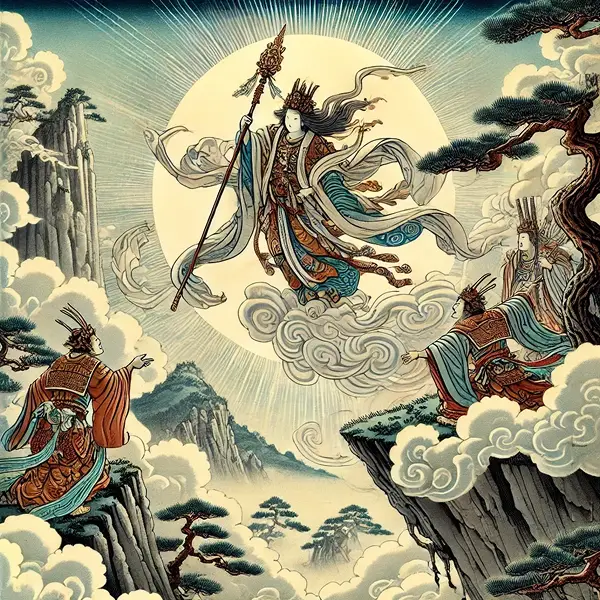
Long ago, the gods of heaven made a decision to entrust the rule of the earthly realm to a descendant of the heavenly gods.
His mission was to bring order, prosperity, and the blessings of harvest to the land below.
This moment came to be known in Japanese mythology as Tenson Kōrin—the Descent of the Heavenly Grandchild.
It marked a dramatic turning point, when the governance of the earthly realm passed into the hands of a lineage descended from the gods of heaven.
But what did this divine arrival truly mean for the world of humans?
In this article, we will explore the story of Tenson Kōrin, the sacred places connected to the legend, and the deeper meaning this myth continues to hold in Japan today.
The Story of Tenson Kōrin
Before the heavenly descent took place, the land of humans had been ruled by the great deity Ōkuninushi.
In a legendary event known as Kuni-yuzuri, the rule of the earthly realm was entrusted to the gods of heaven.
At last, the time had come for a descendant of the heavenly gods to descend and guide the world below.
The story begins with a question among the gods of heaven:
Who should be sent to rule the land of humans?
Let us now follow the legend of Tenson Kōrin.
The Gods Choose a Ruler for the Earth
Long ago, in the heavenly realm known as Takama-ga-hara, the gods gathered to decide who would guide the world of humans.
The sun goddess Amaterasu called forth her son Ame-no-Oshihomimi and spoke to him:
"The land below is ready.
Go down and rule the world of humans."
But Ame-no-Oshihomimi replied gently:
"Before I could descend, a child was born to me.
His name is Ninigi-no-Mikoto.
Perhaps it is he who should be sent to rule the land."
The gods considered this, and Amaterasu agreed.
"Very well.
Let Ninigi descend and guide the world below."
Before his departure, Amaterasu placed three sacred treasures into Ninigi’s hands—the mirror, the sword, and the jewel.
These would later be known as the Three Sacred Treasures of Japan, symbols of divine authority.
She then gave him a final command:
"Go down to the land below.
Bring peace to the world of humans and make the land flourish like the realm of heaven."
And so, Ninigi prepared to descend from the High Plain of Heaven.
As he and the heavenly gods began their journey downward, a mysterious figure appeared between heaven and earth.
His presence shone so brightly that the upper half of his body illuminated the heavens, while the lower half cast its light upon the earth.
Amaterasu wondered who this strange deity might be and sent the goddess Ame-no-Uzume to ask.
The towering god introduced himself.
"I am Sarutahiko.
I have come to welcome the heavenly grandson and guide him safely to the earth."
With Sarutahiko leading the way, the heavenly procession began its descent.
Through layer upon layer of drifting clouds, Ninigi and the gods moved downward from the High Plain of Heaven.
The sky seemed to part before them as they passed between heaven and earth.
Below them lay the mountains of the human world.
At last, the divine company arrived in the land of Takachiho in Kyushu, where Ninigi set foot upon the earth.
There he built a great palace and began his rule.
This legendary descent from heaven became known as Tenson Kōrin — the moment when the lineage of the gods first stepped into the world of humans.
From that moment on, the heavenly lineage took its place in the world of humans.
Interpreting the Myth of Tenson Kōrin
How did you find the story of Tenson Kōrin?
From here, let us explore three intriguing questions hidden within this myth.
By looking more closely at these questions, we can begin to uncover the deeper meaning behind the story and the role it plays within the larger narrative of Japanese mythology.
Why Was Ninigi Chosen Instead of Ame-no-Oshihomimi?
One intriguing question in the story of Tenson Kōrin is why the heavenly descent was entrusted not to Ame-no-Oshihomimi, the son of the sun goddess Amaterasu, but to her grandson Ninigi-no-Mikoto.
This choice may symbolize a gentle transition from the world of the gods to the world of humans.
As Japanese mythology continues beyond this point, the stories gradually move closer to the human realm, eventually forming the lineage that leads to Emperor Jimmu, the first emperor of Japan.
If Ame-no-Oshihomimi himself had descended to the earth, his son Ninigi would have remained in heaven.
In that case, the last generation born in the heavenly realm would never have stepped into the human world.
The myth sends Ninigi — the last generation born in heaven — down to earth.
In doing so, the story creates a clear bridge between the divine world and the human world, while also suggesting the beginning of a new era.
Why Did Amaterasu Give the Three Sacred Treasures to Ninigi?
Before Ninigi descended to the world of humans, Amaterasu entrusted him with the Three Sacred Treasures—the mirror, the sword, and the jewel.
But why would the sun goddess send such precious and sacred objects down to the earth?
A Symbol of Amaterasu’s Divine Presence
First, the treasures symbolized the authority of Amaterasu herself.
The sacred mirror in particular had already appeared in the myth of Ama-no-Iwato, when it was used to draw the sun goddess out of the heavenly cave.
Because of this, the mirror came to be seen as a reflection of Amaterasu herself.
By carrying it to the earth, Ninigi did not descend alone — the presence and authority of the sun goddess accompanied him.
A Sign of Legitimate Rule
Second, the treasures served as a sign of legitimate rule.
Possessing the regalia meant that Ninigi ruled not as a conqueror, but as a leader chosen by the gods of heaven.
The treasures symbolized that his authority came from the divine realm rather than from force.
A Symbol of the Connection Between Heaven and Earth
Finally, the treasures became a symbol of the connection between heaven and earth.
By bringing them into the human world, Ninigi carried with him a reminder that the land of humans was once linked to the realm of the gods.
Through the ages, the sacred treasures would continue to represent this bond between the divine and the earthly worlds.
In this way, Amaterasu did not simply give away precious objects.
Instead, she entrusted Ninigi with symbols that would carry the authority of heaven into the human world and remind future generations of their divine origins.
Why Did Ninigi Descend at Takachiho?
One question still remains in this story: why did Ninigi descend at Takachiho in Kyushu?
After all, the land transferred through the event known as Kuni-yuzuri was Izumo, in present-day Shimane Prefecture, the realm once ruled by Ōkuninushi.
If that land had been entrusted to the heavenly gods, it might seem natural for the heavenly grandson to descend there.
The Shift from Izumo to Kyushu
One way to understand this difference is to consider how the larger narrative of Japanese mythology was formed.
Originally, the myths were a collection of traditions from different regions.
However, the ancient chronicles were ultimately compiled to explain the divine origin of the imperial lineage.
To develop this royal narrative, the focus of the story needed to move away from Izumo and toward regions connected with the later imperial tradition.
The episode of Tenson Kōrin serves as the turning point.
Through this turning point, the stage of the myth shifts dramatically from the land of Izumo to the mountains of Kyushu, setting the path that will eventually lead to Yamato in present-day Nara Prefecture, the future center of imperial rule.
The Beginning of the Imperial Narrative
The imperial lineage traces its origin to the sun goddess Amaterasu.
For this reason, some scholars see the geography of the myth as reflecting the journey of the sun.
In this interpretation, the descent at Takachiho marks the beginning of that path.
From the mountains of Kyushu, the story moves eastward across the land until it reaches Yamato, the later center of imperial rule.
In this way, the movement of the myth across Japan mirrors the path of the rising sun, symbolically linking the imperial lineage with the divine authority of Amaterasu.
A Sacred Mountain Where Heaven Meets the Earth
Another possible explanation lies in ancient mountain worship.
In southern Kyushu, high peaks wrapped in drifting clouds were often regarded as sacred places where the divine could descend into the human world.
Mountains such as Takachiho may therefore have been seen as natural meeting points between heaven and earth, making them a fitting setting for the heavenly descent.
Tenson Kōrin as an Agricultural Myth
The story of Tenson Kōrin is often told as a myth explaining the origin of imperial authority.
But is that the only meaning hidden within this ancient story?
Let us explore another perspective — one that reflects the deep connection between divine authority and the blessings of rice cultivation.
Rice at the Heart of Ancient Japanese Life
In ancient Japan, rice was far more than a staple food.
Rice cultivation formed the foundation of society, sustaining communities and shaping the rhythm of seasonal life.
For this reason, stories about the origin of rule were often closely connected to the blessings of agriculture.
In ancient Japan, rulers were not only political leaders but also ritual figures who were expected to ensure the fertility of the land.
The prosperity of the harvest was believed to reflect the harmony between the gods, the ruler, and the people.
The Divine Gift of Rice
Ancient texts such as the Nihon Shoki describe how Amaterasu entrusted Ninigi with the Sacred Rice of the Heavenly Fields (Yuniwa no Inaho) before his descent to earth.
The sun goddess is said to have instructed him to cultivate this sacred rice upon the earth, so that it might nourish the people of the land.
Through this act, the rice of heaven was brought into the human world, symbolizing the divine blessing of agriculture granted by the gods.
Ninigi and the Symbolism of Rice
Even the name Ninigi is sometimes interpreted as being associated with the image of sacred rice growing and ripening abundantly upon the earth.
From this perspective, the heavenly descent can be seen as the moment when the life-giving power of rice cultivation was brought from heaven to the human world.
Seen in this light, Tenson Kōrin represents not only the beginning of the imperial lineage, but also the symbolic origin of agriculture itself.
Rice Rituals that Continue Today
In fact, this connection between the imperial lineage and rice cultivation has been preserved through Japanese culture and tradition to this day.
For example, the annual Niiname-sai harvest festival offers newly harvested rice to the gods in gratitude for the year’s crops and prayers for the coming harvest.
At the time of imperial accession, the emperor also performs the Daijō-sai, a once-in-a-lifetime ceremony in which newly harvested rice is offered to the deities and then partaken by the emperor himself.
In this way, the ancient myth has become part of sacred rituals that have been carefully preserved throughout Japan’s long history.
Sacred Places of Tenson Kōrin
Although Tenson Kōrin is an ancient myth, there are still places in modern Japan where its story can be felt.
Here, we introduce several locations where traces of the heavenly descent are believed to remain.
Two Places Called Takachiho
The place called Takachiho that appears in the myth is not limited to a single location in modern Japan.
In fact, today the name refers to two different places, both connected with the story of Tenson Kōrin, the heavenly descent.
One is Takachiho-no-Mine, a volcanic peak in the Kirishima mountain range on the border between Kagoshima and Miyazaki Prefectures.
The other is Takachiho Town in Miyazaki Prefecture, a region where many mythological traditions and sacred sites have been preserved.
Neither place can be said to be the single “correct” location of the myth.
Instead, each continues to carefully preserve its own traditions connected with the descent of Ninigi-no-Mikoto, the heavenly grandson sent from Takamagahara, the High Plain of Heaven.
Takachiho-no-Mine — The Mountain of Descent
Let us begin with Takachiho-no-Mine, the volcanic peak in the Kirishima mountain range located on the border between Kagoshima and Miyazaki Prefectures.
Often wrapped in drifting clouds, Takachiho-no-Mine possesses an atmosphere that easily stirs the imagination.
From its summit, the surrounding volcanic landscape stretches far into the distance, creating a quiet sense of grandeur.
At the top of the mountain stands the Ama-no-Sakahoko, a sacred spear closely associated with the legend of the heavenly descent.
According to tradition, it was planted by the heavenly host when they descended from Takamagahara.
Historical records show that the spear was already known during the Edo period, yet its true origin remains uncertain.
Because of this, the object continues to blur the boundary between legend and history.
A small break — a little side note
Ama-no-Sakahoko: The Spear of the Heavenly Descent
Have you ever wondered what the legendary Ama-no-Sakahoko looks like in reality?
At the summit of Mount Takachiho in southern Kyushu stands a mysterious spear said to have been planted there during the heavenly descent of Ninigi-no-Mikoto. No one knows exactly who placed it there or when it first appeared.
Standing quietly on the mountaintop and often surrounded by drifting clouds, the spear carries an air of deep mystery. Some people even imagine that it might truly have been placed there by the gods at the moment of Tenson Kōrin.
This video offers a rare glimpse of the summit of Mount Takachiho and the enigmatic spear that continues to inspire the legend.
Kushifuru Shrine — A Place of the Heavenly Descent
Next, let us turn to Kushifuru Shrine in Takachiho Town, Miyazaki Prefecture.
Kushifuru Shrine enshrines Ninigi-no-Mikoto together with the deities said to have accompanied him from the heavenly realm.
According to local tradition, this area is connected with Kushifuru-no-Mine, the sacred peak believed to be the place where the heavenly grandson descended to the earth.
Nearby are places where the accompanying gods are said to have turned back toward the heavens and offered reverence to Takamagahara that governs the world above.
Standing in this quiet landscape surrounded by mountains, it becomes easy to imagine that moment when the boundary between heaven and earth was believed to open.
For readers interested in learning more about Kushifuru Shrine and its connection to the heavenly descent, the official Takachiho Tourism Association website provides additional information.
(The page opens in Japanese by default, but you can switch to English from the language menu.)
Official Takachiho Tourism Guide – Kushifuru Shrine
Across these mountains and shrines, the story of Tenson Kōrin continues to linger in the landscape.
For those who visit, these places offer a rare opportunity to stand where myth, history, and the natural world quietly meet.
Living Traditions of Tenson Kōrin
The story of Tenson Kōrin can still be encountered today through traditional festivals and performances across Japan.
In Takachiho Town in Miyazaki Prefecture, the famous Takachiho Yokagura is performed each winter.
This sacred dance tradition is based on Japanese myths and legends and is offered annually by local communities.
Among the thirty-three dances that make up the performance, the first seven are considered especially important, and one of them depicts the story of the heavenly descent.
Through music, dance, and ritual storytelling, the performers bring the world of the gods vividly to life within the community.
At Kirishima Shrine, located at the foot of the Kirishima mountains where Takachiho-no-Mine stands, a ritual known as the Tenson Kōrin Sacred Fire Festival is also performed.
During this ceremony, a sacred flame is offered toward the summit of Takachiho-no-Mine, honoring the achievements of the heavenly descent.
Through traditional kagura performances and shrine rituals like these, the memory of Tenson Kōrin continues to be passed down to the present day, reflecting the unique cultural character of each local community.
Conclusion: The Meaning of Tenson Kōrin
The story of Tenson Kōrin stands as an important turning point in Japanese mythology.
Through the descent of Ninigi-no-Mikoto, the world of the gods and the world of humans became closely connected, forming the foundation of the imperial lineage and the myths that follow.
At the same time, the story also reflects deeper themes found in ancient Japanese life.
The divine gift of rice, the relationship between rulers and the fertility of the land, and the sacred landscapes associated with the descent all reveal how mythology, nature, and society were understood as part of a single order.
Even today, these ideas continue to live on through sacred places such as Takachiho, through traditional performances like kagura, and through rituals that preserve the memory of the gods.
In this way, the myth of Tenson Kōrin is not merely a story of the distant past.
Rather, it remains an enduring trace of how the people of Japan have long understood the relationship between the divine, the land, and human life, and how these ideas continue to live on through the traditions and culture of the present day.