Ōkuninushi-no-Mikoto:The God Who Shaped the Land and Chose to Watch Over It
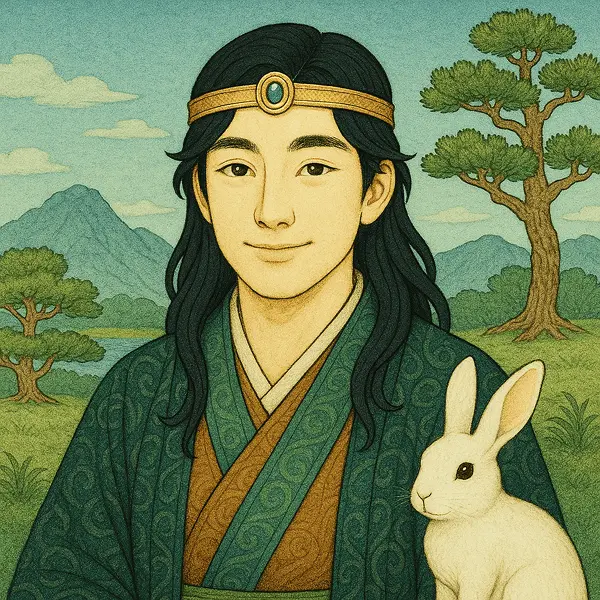
Do you know which god was entrusted with the creation of Japan and brought it to completion?
In Japanese mythology, that god is Ōkuninushi-no-Mikoto.
Though repeatedly oppressed and pushed into countless dangers and hardships, he continued to fulfill his mission with the help of many others — even while facing death again and again.
Why was Ōkuninushi able to receive so much support from those around him?
Why did his life not come to an end, even after death?
Let us set out together on a journey to learn about Ōkuninushi-no-Mikoto.
Through his turbulent life, we will explore the mindset and posture that made him so deeply loved, as well as the deeper meaning behind his relentless efforts to carry out the role entrusted to him.
Who Is Ōkuninushi-no-Mikoto?
Before exploring the deeper questions surrounding Ōkuninushi-no-Mikoto, let us first understand who he is as a god within Japanese mythology.
A Simple Profile of Ōkuninushi-no-Mikoto
Ōkuninushi-no-Mikoto is widely known as the deity entrusted with the ordering and management of the land of Japan.
Rather than ruling through force, he is remembered as a god who shaped society itself — teaching agriculture, medicine, and the foundations of communal life.
To better understand Ōkuninushi-no-Mikoto’s role and position among the gods, here is a brief overview:
| Category | Details |
|---|---|
| Father | Amenofuyukinu-no-Kami |
| Mother | Sashikuni-wakahime |
| Lineage | Descendant of Susanoo-no-Mikoto |
| Associated Region | Izumo (present-day Shimane Prefecture) |
| Key Domains | Agriculture, healing, social order, relationships |
| Distinctive Trait | A god who overcomes hardship through endurance, cooperation, and trust |
Names and Their Meanings
Ōkuninushi-no-Mikoto was not always known by this name.
Before his descent to the underworld (Ne-no-Kuni) and the trials he faced there, he was known as Ōanamuchi-no-Kami or Ōnamuchi-no-Mikoto.
The element -muchi (貴) carries the meaning of “a noble” or “precious deity,” and only a small number of gods in Japanese mythology are honored with this title.
This suggests that even before his rise, Ōkuninushi was regarded as a being of exceptional importance.
The name Ōkuninushi-no-Mikoto, meaning “Great Master of the Land,” was bestowed upon him after he overcame the trials imposed by Susanoo in the underworld.
Across various regional records (Fudoki), he is also known by many other names, reflecting his widespread worship and deep local roots.
Family, Marriage, and Relationships
Ōkuninushi is especially notable for his many marriages, a feature that highlights his strong association with relationships and human bonds.
Across different regional traditions and mythological accounts, he is said to have taken numerous consorts.
Among his most well-known consorts are:
- Suseri-bime, daughter of Susanoo-no-Mikoto
- Yagami-hime, who chose him over many rivals
- Takiri-bime, also a daughter of Susanoo-no-Mikoto
- Numakawa-hime, later known as the mother of Takeminakata-no-Kami
These relationships are not merely romantic episodes, but form an important part of his mythological role as a god who connects people, lands, and destinies.
Ōkuninushi in Mythology
Several major mythological narratives center on Ōkuninushi-no-Mikoto, including:
- The White Hare of Inaba, which reveals his compassion and judgment
- The Trials of the Underworld (Ne-no-Kuni), where his endurance and resolve are tested
- The Creation and Ordering of the Land, in which he builds the foundations of society
- The Transfer of the Land (Kuniyuzuri), where he relinquishes power for the sake of cosmic order
Through these stories, Ōkuninushi emerges not simply as a ruler, but as a god entrusted with responsibility — one who bears hardship, survives death, and continues forward until his role is fully complete.
Mythological Episodes
Ōkuninushi-no-Mikoto appears in many mythological narratives, but one episode stands out above all others — the persecution he suffered at the hands of the Yaso-gami, where he was brought face to face with death itself.
Remarkably, Ōkuninushi returns from death — not once, but repeatedly.
In this section, we will explore why death was not allowed to mark the end of his life.
Death at the Hands of the Yaso-gami
After Ōkuninushi won the hand of Yagami-hime, the Yaso-gami were consumed by jealousy.
Unable to accept his growing recognition, they devised a cruel plot to remove him from their path.
Ōkuninushi was deceived — and killed with alarming ease.
Yet his story did not end there.
Through the intervention of other gods, he was restored to life.
Learning of his return, the Yaso-gami did not relent.
They plotted once more, and once more succeeded in killing him.
And yet, again, Ōkuninushi returned from death.
Twice he was struck down, and twice he was brought back by the hands of the gods — an extraordinary fate that sets him apart from nearly all other deities in Japanese mythology.
Such repeated returns from death raise a deeper question — why was Ōkuninushi not allowed to remain dead?
A Mission That Could Not Be Left Unfinished
Ōkuninushi’s return from death was not the result of mere pity, nor was it granted because he was loved without condition.
In Japanese mythology, even within the realm of the gods, death is not something that can be easily overturned.
Once a life comes to an end, it is generally meant to remain so.
For this reason, the fact that Ōkuninushi returned from death again and again feels profoundly exceptional.
Yet his revival suggests that it was not optional — it was necessary.
Ōkuninushi was not permitted to die because he still had a role to fulfill.
At the moment of his death, the task entrusted to him remained incomplete.
The shaping of the land — the creation of a place where people could live in peace, find healing, and form lasting connections — had not yet been finished.
Seen in this light, Ōkuninushi’s return from death was not a reward, but a continuation of responsibility.
His revival marked not an escape from death, but the persistence of a mission that could not yet come to an end.
Why Help Gathered Around Ōkuninushi
Ōkuninushi’s return from death was not the only moment in which help was extended to him.
In truth, it was merely one example among many instances of support he received from other gods.
Why, then, was Ōkuninushi so consistently supported by those around him?
In this section, we will take a closer look at the reasons behind the help that gathered around him.
Help That Appeared Along His Journey
Throughout Ōkuninushi’s story, there are several well-known moments in which help quietly appears.
For example, during the trials of the underworld (Ne-no-Kuni), Ōkuninushi gained guidance and insight from Suseri-bime.
Later, when his efforts at shaping the land reached an impasse, gods such as Sukunahikona-no-Kami and Ōmononushi-no-Kami appeared to assist him.
In this way, Ōkuninushi’s life was sustained many times through the help of others.
However, this does not suggest that he was weak or unable to stand on his own.
The myths never portray him as someone who expected to be saved.
Rather, Ōkuninushi consistently strives to overcome hardship through his own effort.
The Quiet Strength That Draws Support
Even when faced with great difficulty, Ōkuninushi does not wait passively for rescue, but continues forward with steady resolve, carrying the responsibilities entrusted to him.
Perhaps this posture is the key.
Those who do not act in anticipation of being saved, yet continue to move forward with sincerity and perseverance, often become the ones others feel compelled to support.
People who confront their responsibilities earnestly and with determination have the power to stir the hearts of those around them.
Ōkuninushi’s story stands as a clear symbol of this truth.
It reveals that help does not gather around those who depend on rescue, but around those who face responsibility without relying on it.
His life shows that being supported is not the opposite of self-reliance.
It is, instead, something that emerges when one remains committed to a role and purpose larger than oneself.
A Decision He Chose Not to Make Alone
Another moment that clearly reveals Ōkuninushi’s character appears in the story of the transfer of the land.
When asked whether he would yield the land, Ōkuninushi does not give an answer himself.
Instead, he entrusts the decision to his sons.
This choice does not reflect an attempt to avoid responsibility, nor does it suggest weakness of will.
Rather, it reveals how Ōkuninushi understood the land he had built.
To him, the land was never something that belonged to him alone.
It was a place created for all who lived there — for the people, their lives, and the society they formed together.
For this reason, he believed the decision should not be made by a single individual, but should reflect the voices of the next generation, who would shape the future of the land.
Such a mindset — acting not for oneself, but for others — naturally earns trust.
It is likely this way of thinking that drew the confidence and support of those around him.
In this light, Ōkuninushi’s willingness to place the future in others’ hands may also explain why so many were moved to help him throughout his life.
Shrines and Worship of Ōkuninushi
After the transfer of the land, Ōkuninushi stepped back from the center of the mythic stage and became a god who quietly watches over the land and its people.
Today, he continues to be enshrined at shrines across Japan.
Here, we will introduce some of the most representative places where Ōkuninushi’s presence can still be felt.
Izumo Taisha: Watching Over the Land He Once Shaped
The most important shrine dedicated to Ōkuninushi is Izumo Taisha, located in Shimane Prefecture.
It is one of the oldest and most revered Shinto shrines in Japan and stands at the heart of his mythology.
At Izumo Taisha, Ōkuninushi is revered as a god who guides people toward happiness through the power of connection, often described as en-musubi, the binding of meaningful relationships.
He is worshipped as a deity who watches over human relationships, cooperation, and the unseen bonds that hold society together.
For those who wish to learn more about Izumo Taisha, please visit the shrine’s official website:
Official Website of Izumo Taisha
Kanda Myōjin: Ōkuninushi in the Heart of Modern Tokyo
Ōkuninushi is also worshipped far from ancient Izumo, including in the center of modern Tokyo at Kanda Myōjin.
Here, he is enshrined as one of the principal deities and is widely known as a god of relationships, prosperity, and cooperation.
Surrounded by offices, shops, and busy streets, Kanda Myōjin presents a vivid example of how Ōkuninushi’s worship continues in everyday life.
Rather than being confined to mythic history, his role has adapted to support human connections within contemporary society.
For those who wish to learn more about Kanda Myōjin, please visit the shrine’s official website:
Official Website of Kanda Myōjin
These shrines reflect the deep reverence felt by the people of Japan toward Ōkuninushi, the deity who helped shape the land that has endured into the present day.
They also embody the heartfelt wish to share in the power through which he connected people and destinies in myth — a hope that such bonds may continue to bring happiness to their own lives.
Even today, the qualities celebrated in Ōkuninushi’s stories — harmony, trust, and human connection — remain universal ideals that people continue to seek.
Conclusion: The Enduring Spirit of Ōkuninushi
Ōkuninushi is a god who overcame countless hardships while devoting himself to the shaping of the land of Japan.
His story is a grand narrative of perseverance — a tale in which he repeatedly faces death, returns to life, and continues to fulfill the mission entrusted to him until the very end.
His sincere and steadfast efforts naturally stir the hearts of those around him, leading others to offer their support.
After completing the work of nation-building, he steps back from the forefront and chooses to pass the land on to the next generation — an act guided not by personal ambition, but by a deep concern for the future of society.
This spirit continues to live on in the way he is revered today.
Even now, Ōkuninushi is believed to quietly watch over human relationships, cooperation, and the bonds that sustain everyday life.
From his story, we can still learn much.
When faced with challenges, it is not the expectation of being helped that moves others, but the willingness to act with resolve and take responsibility.
Likewise, choosing to act not only from one’s own perspective, but with consideration for those around us, is what earns trust and lasting respect.
These values — responsibility, cooperation, and care for others — are timeless.
They are ideals that remain just as meaningful today as they were in the age of the gods.