The White Hare of Inaba: A Japanese Myth of Choice, Consequence, and Compassion
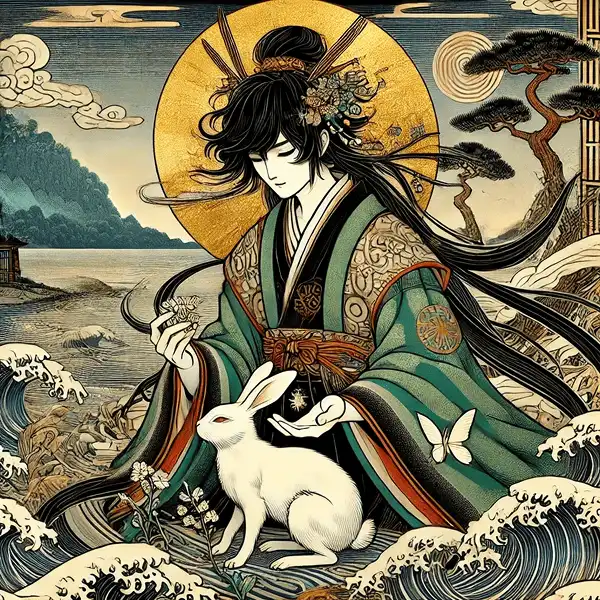
If a small white rabbit were crying in pain — what would you do?
In Japanese mythology, there is a story about such a rabbit.
Some laughed at his suffering.
One person quietly chose to stop and help.
This is the tale of The White Hare of Inaba.
Why did the rabbit come to be wounded?
And how did the choices of those who met him shape the path that followed?
As we step into this ancient story, let us gently reflect on what it may still be asking of us today.
The White Hare of Inaba: The Story
Let us first step into the world of The White Hare of Inaba.
A Journey Begins for the Gods
In an age long past, the Eighty Deities set out on a journey to seek the hand of Princess Yagami of Inaba.
Confident in their own worth, each believed he would be chosen.
Their youngest brother, Ōnamuchi — later known as Ōkuninushi — walked behind them.
He carried their baggage and followed at a distance, enduring their laughter without protest.
To his brothers, he was little more than a servant.
A Rabbit Who Wanted to Cross the Sea
On a distant island lived a small white rabbit.
He longed to reach the land of Inaba, but the sea stretched wide before him.
“How can someone as small as me cross such waters?”
he wondered.
An idea suddenly came to him.
In the sea below swam powerful great sea sharks.
The rabbit called out to them with feigned confidence.
“Shall we have a contest?”
he said.
“Let us see whose clan is greater in number — yours or mine.”
Intrigued, the sharks agreed to line up from the island to the shore.
The rabbit stepped lightly across their backs, counting as he went.
But as he reached the final shark, he laughed and revealed the truth — he had only wished to cross the sea.
The sharks grew angry at his deception.
They tore away his fur, leaving him wounded and trembling on the shore.
His trick had carried him across the sea — but it had also led to his suffering.
Mockery on the Road
As the rabbit lay suffering, the Eighty Deities happened upon him.
Seeing his wounded body, they laughed.
“If you wish to heal,”
they told him,
“bathe in the salt sea and let the wind dry you.”
Trusting their words, the rabbit obeyed.
The salt burned his wounds, and his pain grew sharper.
The gods watched him suffer, laughed, and walked away.
The One Who Stopped
Later, Ōkuninushi approached, still bearing the heavy loads of his brothers.
When he saw the rabbit, he stopped.
“What has happened to you?”
he asked.
The rabbit spoke honestly — of his longing, his deception, and his regret.
Ōkuninushi listened without anger.
“Wash yourself in fresh water,”
he said gently.
“Then rest upon the soft pollen of the cattail reeds.”
The rabbit did as he was told.
Gradually, the pain eased.
His fur returned, and he stood once more in his true form.
A Quiet Prophecy
Grateful, the rabbit bowed.
“Your brothers will not be chosen,”
he said softly.
“But you will win Princess Yagami’s heart.”
With that, the rabbit revealed what was to come.
The journey continued.
Just as the White Hare had foretold, Princess Yagami did not accept the proposals of the Eighty Deities.
Instead, she chose Ōkuninushi.
What Lies Within the Story
How did you find the story of The White Hare of Inaba?
At first glance, it may seem like a simple tale in which a wounded rabbit is saved by a kind-hearted god.
Yet when we look more closely, we begin to sense that something else is quietly unfolding beneath the surface.
Let us return to the story once more, paying attention to the actions of each character — and to what follows as a result.
When Deception Leads to Pain
Let us begin with the white rabbit, who wished to cross the sea.
In order to reach the shore, he deceives the sharks.
For a brief moment, his clever plan succeeds.
But when the truth is revealed, the sharks grow angry.
As a result, the rabbit is wounded and left in pain.
His act of deception returns to him in the form of suffering.
When Cruelty Returns as Loss
Next, let us turn to the Eighty Deities.
When they encounter the wounded rabbit, they pretend to offer help, but instead give him false advice.
They even laugh as his pain grows worse.
In time, their true nature becomes clear.
Princess Yagami does not accept their proposals.
Their cruelty, too, returns to them — this time in the form of rejection.
When Honesty Opens the Way to Healing
The return of our actions is not limited to wrongdoing alone.
Let us look again at the white rabbit and see what follows.
After suffering from his wounds, the rabbit does not try to hide his mistake.
He speaks honestly of his deception and his regret.
As a result, Ōkuninushi offers him guidance, and the rabbit is able to heal.
Because he faces his wrongdoing openly, he becomes able to receive help.
His honesty becomes the beginning of his healing.
When Compassion Shapes What Follows
Finally, let us turn to Ōkuninushi.
When he encounters the wounded rabbit, he responds differently from the Eighty Deities.
He listens to the rabbit’s story and teaches him the proper way to heal his wounds.
Princess Yagami recognizes his compassionate heart and chooses him as her husband.
In this way, his kindness leads him toward marriage.
A Repeating Pattern
In this way, we can see that the story of The White Hare of Inaba contains more than one example of cause and return.
- Deception gives rise to suffering.
- Cruelty leads to loss.
- Honesty opens the way to healing.
- Compassion shapes the future.
The story does not force this lesson upon us.
It simply allows each action to unfold into its natural result.
Through these repeated patterns, we begin to notice that harmful actions lead to painful outcomes, while acts of sincerity and kindness lead to something different.
Perhaps the same may be true in our own lives.
What we give to others — whether harm or kindness — may one day return to us.
The story of The White Hare of Inaba gently leaves that thought in our hands.
Symbols in the Story: The Rabbit and the World He Encounters
There is another layer of this story worth noticing.
When we look at the tale with the white rabbit as its central figure, the world around him begins to carry a different meaning.
Let us gently explore the symbolic layer that may be hidden within this story.
The Rabbit: A Mirror of Ourselves
The white rabbit devises a plan in order to reach the distant shore.
He schemes, he deceives the sharks, and he suffers for it.
Later, he feels regret and learns from what has happened.
He is imperfect, and yet there is something deeply relatable in his struggle.
Perhaps this is because the rabbit may be read as a reflection of ourselves.
In our own lives, we often search for ways to achieve what we desire.
At times, we may choose misguided paths, act unfairly, or come to regret our decisions.
And yet, through such experiences, we learn.
We grow.
We move forward into the next stage of our lives.
In the rabbit’s earnest struggle, we may recognize something of our own journey.
The Sea: The Distance We Wish to Cross
If the white rabbit reflects something of ourselves, then what might the wide sea represent?
It may stand for the distances in our own lives — the things we long for but cannot yet reach, the barriers that rise before our desires.
Standing before the sea, the rabbit must decide how to cross it.
In much the same way, we, too, must consider how we move forward when faced with what feels beyond our grasp.
The way we choose to cross our own seas — the risks we take, the paths we attempt — becomes part of our story.
The Sharks: The World That Cannot Be Used Without Consequence
Let us also consider what the sharks may symbolize.
As they line up across the water, they appear to offer a solution — a living bridge toward the shore.
For a moment, they seem like an answer.
And yet, each shark is a being with its own strength and pride.
In our own lives, they may represent other people — not tools to be used, but individuals with their own dignity.
When we attempt to treat others merely as stepping stones for our own gain, something fragile can be broken.
Trust may weaken.
Resentment may grow.
The sharks seem to remind us that the world is not here for our benefit alone.
Perhaps the story quietly suggests the importance of meeting others with respect — and remembering that every relationship carries weight.
The Cattail Reeds: Quiet Restoration
Finally, let us consider what the cattail reeds may represent.
In the story, they serve as the means by which the rabbit’s wounds are healed.
In our own lives, they may suggest moments of turning — times when we begin to recover from hardship.
Such moments may come in the form of unexpected kindness, a gesture of compassion, or an encounter that gently guides us toward something better.
The reeds do not force healing;
they support it quietly.
Perhaps they remind us that life is not sustained by our efforts alone.
Often, we are upheld by the warmth and care of others.
A Journey Reflected in Images
Seen in this way, the story becomes more than a tale of gods and animals.
It becomes a reflection of a human journey:
- A desire that feels distant.
- A risky attempt to reach it.
- The pain that follows misjudgment.
- And the quiet possibility of renewal.
Through him, we may be invited to see not only a myth of the gods, but a mirror of our own lives.
Places and Sweets Inspired by The White Hare of Inaba
You may think that The White Hare of Inaba exists only in the world of myth.
Yet traces of the story can still be found in real places today.
Here are a few special locations and treats inspired by the legend.
Hakuto Shrine: A Shrine Dedicated to the White Hare
Hakuto Shrine is a sacred place where the White Hare is enshrined as a divine being.
Because the hare was healed using cattail reeds in the legend, the shrine is often regarded as the birthplace of Japanese medicine and healing traditions.
The shrine is also closely associated with matchmaking and meaningful relationships.
After all, it was the White Hare who foretold the union between Ōkuninushi and Princess Yagami.
For this reason, many visitors come here seeking good fortune in love and human connections.
Charms and fortune slips at the shrine often feature rabbit designs inspired by the legend, adding a gentle touch to the experience.
People visit Hakuto Shrine to pray for recovery from illness, compassion toward others, and deeper bonds in their lives.
The quiet atmosphere invites visitors to slow down and reflect — much like Ōkuninushi did when he stopped to help the wounded rabbit.
Learn more about Hakuto Shrine:
Hakuto Shrine
Hakuto Coast: The Shore Where the Legend Unfolds
Hakuto Coast is believed to be the place where the White Hare crossed the sea.
Along the shore, rock formations resemble the backs of sharks, echoing the scene from the legend.
The gently curving coastline is strikingly beautiful, and the clear water reveals grains of sand beneath the surface.
Sunrise and sunset at Hakuto Coast are especially breathtaking, as the sky and sea change color in quiet harmony.
Standing here, it is easy to imagine the rabbit’s journey.
The vast ocean can feel like the very sea he once faced.
Learn more about Hakuto Coast:
Hakuto Coast
A Sweet Inspired by the Legend
The story of The White Hare of Inaba has also inspired a beloved local confection.
Inaba no Shiro Usagi is a small, palm-sized sweet shaped like a white rabbit, with distinctive red eyes.
The soft dough is made with butter, and inside is a gentle egg-yolk bean paste, creating a mild and comforting flavor.
For many years, this sweet has been created and enjoyed with the wish that happiness and good relationships may come into one’s life — reflecting the gentle spirit of the White Hare’s story.
Tasting this confection is another way to experience how the story continues to live in everyday life — not only through words and places, but through flavors passed down across generations.
Official website of Inaba no Shiro Usagi:
Inaba no Shiro Usagi (Japanese only)
From sacred shrines and coastal landscapes to local sweets, The White Hare of Inaba remains a living story — one that can be walked, seen, and tasted, and quietly remembered.
Conclusion: A Story That Walks Beside Us
The White Hare of Inaba is not merely an ancient myth.
It is a story that walks quietly beside us, reflecting something deeply human.
Through the actions of the White Hare, the Eighty Deities, and Ōkuninushi — and the consequences that follow — the tale gently places a question before us.
When someone is suffering, will we pause?
Will we offer a hand?
Such small choices may one day return to us in unexpected ways.
Through the White Hare, we are also invited to see the many stages of a human life.
The walls that seem impossible to cross.
The misjudgments we come to regret.
The lessons learned through pain.
And the quiet courage to begin again.
The story reminds us that we do not walk alone.
We are supported by others, shaped by kindness, and sustained by warmth we may not always notice.
Even now, the legend lives on — in shrines, in landscapes, and in simple sweets passed down through generations.
In this way, the story does not remain in the past.
It lives quietly in the way we choose to act toward one another.