Iwanaga-hime: The Goddess of Endurance and Unseen Value
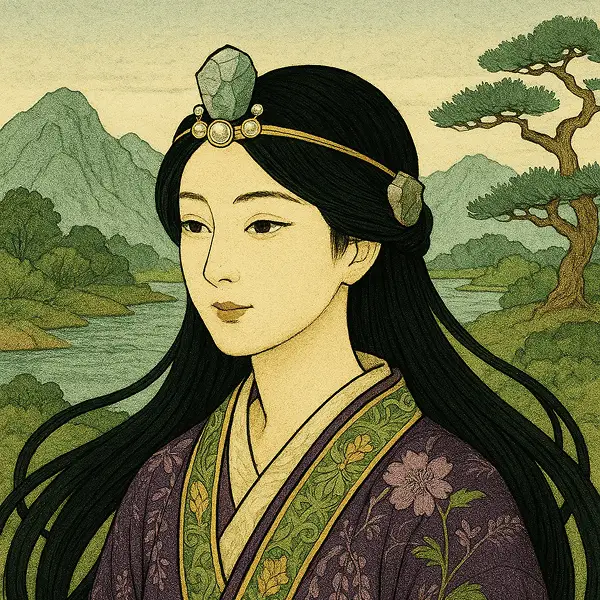
Do you know the name of the Japanese goddess who once held the promise of eternal life for humanity?
Her name is Iwanaga-hime.
She embodied endurance, permanence, and time without end — everything that lasts, everything that does not fade away.
Yet, she was not chosen.
And with that single choice, the dream of eternal life quietly slipped out of human reach.
Why was a goddess who symbolized eternity turned away?
And what became of her after she was no longer chosen?
Let's set out on a gentle journey to discover Iwanaga-hime — to understand the meaning of her existence, the value that was overlooked, and the quiet message she left behind for those who continue to live in a fleeting world.
Who Is Iwanaga-hime?
Before exploring the stories surrounding her, let us first take a brief look at who Iwanaga-hime is and what she represents in Japanese mythology.
A Goddess of Endurance Reflected in Her Name
Iwanaga-hime is a goddess who embodies endurance and permanence, symbolized by solid rock.
Like stone that does not fade with time or break easily, she represents a quiet strength — one that remains unchanged even as the world around it shifts and passes away.
Because of this unchanging nature, Iwanaga-hime is also associated with longevity and the idea of life that continues without end.
These qualities are clearly reflected in her name.
The name Iwanaga-hime is made up of three parts:
- iwa — rock
- naga — eternal or long-lasting
- hime — princess or noble woman
When combined, her name conveys the image of a goddess who remains unchanged like rock, enduring through endless time.
Family Ties and a Goddess of Contrast
Iwanaga-hime is the daughter of the mountain god Ōyamatsumi-no-Kami.
She is also the elder sister of the renowned and beautiful goddess Konohanasakuya-hime.
The two sisters embody qualities that stand in clear contrast to one another.
| Iwanaga-hime | Konohanasakuya-hime |
|---|---|
| Endurance and permanence | Beauty and transience |
| Rock | Flower |
| Long-lasting, unchanging time | A moment that blooms and fades |
| Longevity and stability | Youth, vitality, and brilliance |
This contrast does not suggest superiority or inferiority.
Rather, it reflects two fundamentally different ways of existing in the world.
In Japanese mythology, the difference between these two natures becomes a key element in determining the limits of human life.
Through their contrasting qualities, the myths express how choice, time, and existence are shaped — not by good or bad, but by the nature one embraces.
Mythological Episode: Is Iwanaga-hime Truly Without Value?
Now that we have come to know Iwanaga-hime, let us turn to her well-known myth and reflect together on what her true value may have been.
A Choice That Shaped Human Life
The story of Iwanaga-hime is best known through the tale of a marriage choice made by the heavenly descendant Ninigi-no-Mikoto.
Captivated at first sight by the beauty of Konohanasakuya-hime, Ninigi-no-Mikoto asked for her hand in marriage.
Her father, the mountain god Ōyamatsumi-no-Kami, was delighted by the proposal and offered not only Konohanasakuya-hime, but her elder sister, Iwanaga-hime, as well.
However, Ninigi-no-Mikoto chose only Konohanasakuya-hime, whose beauty was like a flower in full bloom.
Iwanaga-hime, whose appearance was considered plain, was sent back to her father.
Upon learning of this choice, Ōyamatsumi-no-Kami declared that human life would no longer be eternal.
From that moment on, humanity was destined to live with youth as fleeting as blossoms and with lives that must one day come to an end.
Note: This version of the story follows the Kojiki.
In the Nihon Shoki, it is Iwanaga-hime herself — rather than her father — who declares the limits of human life.
Was Iwanaga-hime Rejected Because She Lacked Value?
At first glance, this episode may seem to suggest that Iwanaga-hime was rejected because she lacked value.
Yet what she embodied was endurance, permanence, and time without end — the promise of eternal youth and life itself.
These are qualities humanity has continued to desire across countless generations.
Seen in this light, the worth of Iwanaga-hime is undeniable.
Humans often choose what is immediately visible and striking.
However, what is not chosen does not lose its value.
Even today, the qualities Iwanaga-hime represents — longevity, unending life, and enduring strength — remain objects of human longing.
Her rejection did not erase her worth; it revealed how easily true value can be overlooked.
What the Myth Quietly Reveals
At least in the version recorded in the Kojiki, Iwanaga-hime neither curses humanity nor harbors resentment toward the one who rejected her. She quietly steps away from the center of the story and disappears from its visible stage.
Yet her presence — and the choice made in turning her away — leads to consequences that shape the very nature of human existence.
What was lost was not Iwanaga-hime’s value itself, but the opportunity to recognize that value.
Through this myth, we are left with a quiet question:
was her worth truly understood at the moment she was rejected?
Rather than offering an answer, the story leaves that question with us — inviting reflection, not judgment.
Iwanaga-hime Did Not Disappear
After quietly stepping away from the center of the myth, what became of Iwanaga-hime thereafter?
In the continuation of the story recorded in the Kojiki, a goddess named Konohana-chiru-hime appears.
She is said to have married into the lineage of Susanoo-no-Mikoto, and through several generations, this line leads to the birth of Ōkuninushi-no-Mikoto, one of the most important deities in Japanese mythology.
Many scholars interpret Konohana-chiru-hime as the same goddess as Iwanaga-hime, or as another name reflecting a different role of the same divine identity.
Rather than standing at the forefront of dramatic events, she appears within the genealogies — quietly passing the torch that would lead to the birth of a great god.
In this way, it feels as though Iwanaga-hime entrusted her own nature — endurance and unending time — to the lineage that would continue across generations.
She may not have achieved visible glory within the main narrative of the myths.
Yet what she accomplished through succession and continuity is vast and profound.
By embodying permanence not through action, but through inheritance, Iwanaga-hime fulfilled her nature in a way that reaches far beyond a single story.
Shrine and Worship: Iwanaga-hime Today
Even today, there are shrines and local traditions through which the presence of Iwanaga-hime can still be felt.
She is most often worshipped alongside other deities, and it is rare for her to be enshrined alone as the primary kami.
Here, we will introduce a few such shrines where stories and traditions connected specifically to Iwanaga-hime have been carefully preserved.
Kumomi Sengen Shrine
According to local legend, after being sent back by Ninigi-no-Mikoto, Iwanaga-hime retreated in sorrow and chose to live in seclusion in the area of Kumomi.
Kumomi Sengen Shrine is said to enshrine Iwanaga-hime alone — making it one of the very few shrines dedicated solely to her.
The shrine stands near Mount Fuji, the mountain most strongly associated with her younger sister, Konohanasakuya-hime.
Local folklore tells of a rift between the sisters caused by Ninigi-no-Mikoto’s choice.
It is said that when Mount Eboshi, where the shrine is located, is clear, Mount Fuji is hidden in clouds — and when Mount Fuji is visible, the weather around Eboshi worsens.
Another tradition warns that speaking of Mount Fuji while visiting Kumomi Sengen Shrine may invite misfortune, reflecting the lingering sorrow said to remain between the sisters.
Today, the shrine is revered as a place of prayer for longevity, release from hardship, and new, favorable connections — blessings that echo Iwanaga-hime’s enduring nature.
A small break — a little side note
Kumomi Sengen Shrine — Where Iwanaga-hime Still Watches Over the Sea
What kind of place is Kumomi Sengen Shrine, a rare shrine dedicated solely to Iwanaga-hime?
In this video, take a gentle walk through Kumomi Sengen Shrine, standing on a rugged cliff overlooking the sea.
The steep stone steps leading upward feel almost like a reflection of Iwanaga-hime’s story — a quiet retreat from the human world, shaped by sorrow and solitude.
Yet at the summit, where the main sanctuary and observation point stand, a breathtaking view opens wide.
The vast ocean and open sky create a sense of release and quiet hope.
It feels as though this place does more than preserve a story of sorrow.
Like Iwanaga-hime herself, who passed her legacy forward through continuity and succession, the view from the shrine seems to offer visitors a gentle threshold — an opening toward what lies ahead.
Shiinomine Shrine (Ginkyo Shrine)
At Shiinomine Shrine, also known as Ginkyo Shrine, a different legend of Iwanaga-hime is preserved.
According to local tradition, Iwanaga-hime once gazed into a mirror and lamented her own appearance.
In grief, she cast the mirror away.
It became lodged in a tree atop Mount Ryūbō, a mountain overlooking the shrine, where it continued to shine brightly, illuminating the surrounding land.
Because of this radiant mirror, the village came to be known as Ginkyo (銀鏡) — “Silver Mirror.”
While the shrine enshrines multiple figures, including Ōyamatsumi-no-Kami, the mirror of Iwanaga-hime is revered as one of its sacred objects.
Each December, the shrine hosts the Ginkyo Kagura, an all-night ritual dance that continues to this day.
Here, Iwanaga-hime is worshipped as a deity of long life, health, and enduring vitality, with prayers offered for a life that remains strong through time.
Through these shrines, Iwanaga-hime is remembered not as a goddess who vanished, but as one who remained — quietly embedded in the land, its mountains, and the lives of those who continue to pray.
Conclusion: What Iwanaga-hime Teaches Us
Iwanaga-hime is not a goddess who shines as a heroine, nor one who leaves behind visible, celebrated achievements.
Her story is quiet and somber, and she often seems to remain at the margins of myth.
Yet through her very existence, and through the choices made around her, something essential is revealed.
The value Iwanaga-hime embodied could not be measured by a single moment of selection.
Just as humanity continues to long for eternal youth and life, the qualities she represents — endurance and permanence — remain universal and deeply precious.
Though she stepped away from the center of the narrative, Iwanaga-hime did not fade away.
Through lineage, through inherited stories, and through enduring worship, she has continued to be remembered into the present day.
In this way, she realized permanence not through brilliance, but through continuity and succession.
In a world where what shines most brightly tends to draw our attention, Iwanaga-hime gently asks us to look again.
To remember that brilliance alone is not everything.
And that the quiet strength to endure is also an essential force that sustains this world.