The Tengu: Mysterious Mountain Spirits of Japanese Folklore
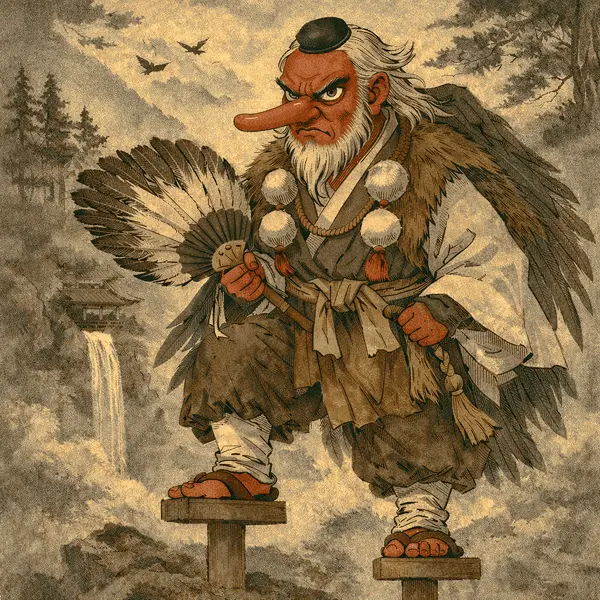
High in Japan’s mountains, it is said that mysterious beings watch quietly from the shadows of the trees.
Have you ever heard of the tengu (天狗)?
With bright red faces and long noses, these strange figures are said to fly freely through the forests and mountains of Japan.
But what exactly are they?
Are they humans, gods, or something in between?
In this article, we will explore the origins of the tengu, their transformation through history, their role in faith and folklore, and the famous places where their legends are still remembered today.
Let us step into the world of the tengu and quietly explore the mystery surrounding these fascinating beings.
What Is a Tengu?
Before exploring its deeper history and meanings, let us first look at the general characteristics of the tengu.
In Japanese folklore, the tengu is a mysterious supernatural being strongly associated with the mountains.
It is sometimes described as a yokai, a powerful spirit, or even a deity-like being.
For this reason, the tengu is a complex figure that does not easily fit into a single category.
Common Characteristics
The following table summarizes the characteristics most commonly associated with tengu.
| Aspect | Description |
|---|---|
| Category | Supernatural being, often described as a yokai, spirit, or deity-like being |
| Appearance | Red face, long nose, wings, and clothing resembling a yamabushi (mountain ascetic monk) |
| Abilities | Flight, transformation, supernatural power (jinzūriki), and mastery of martial arts |
| Symbolic Item | Feather fan (hauchiwa), believed to possess magical power |
| Habitat | Mountains and remote forests |
| Role in folklore | Sometimes protects sacred places, but may also mislead or challenge humans |
The Two Main Types of Tengu
Tengu are generally divided into two main types: daitengu and karasu tengu. Both belong to the world of the tengu, yet their appearances and roles can differ depending on the era and the stories in which they appear.
Let us take a brief look at the characteristics of each.
Daitengu (大天狗)
Daitengu are tengu believed to possess powerful supernatural abilities (jinzūriki).
The familiar image of the tengu known today is largely based on the appearance of the daitengu.
They are typically depicted with red faces and long noses, wearing the clothing of a yamabushi and carrying a feather fan (hauchiwa).
They are also often shown wearing single-toothed wooden clogs (tengu-geta), and in some depictions they have wings that allow them to fly through the mountains.
Among the tengu, daitengu are often regarded as powerful leaders.
Karasu Tengu (烏天狗)
The name karasu tengu literally means “crow tengu.”
They are depicted with bird-like beaks and are sometimes said to be covered in dark feathers resembling birds of prey.
Before the long-nosed daitengu became the dominant image of the tengu, this crow-like form was commonly recognized as the appearance of the tengu in earlier legends.
Karasu tengu are known for their agility and are often described as highly skilled in swordsmanship.
Because they sometimes appear as attendants or followers of the daitengu, they are also referred to as kotengu (小天狗, “lesser tengu”).
We have briefly introduced what a tengu is, but how did this mysterious being come to take the form we recognize today?
The image of the tengu did not emerge all at once.
Instead, it gradually evolved over centuries through the influence of religion, folklore, literature, and art.
To understand this transformation, let us now look at the historical records and stories that reveal how the image of the tengu changed over time.
The Changing Image of the Tengu (Part I): From Heavenly Omen to Mountain Spirit
Let us begin by exploring how the earliest images of the tengu evolved from ancient times through the medieval period.
Early Records: A Mysterious Celestial Phenomenon
The earliest known reference to the word tengu appears in the Nihon Shoki (Chronicles of Japan), compiled in the 8th century.
In a record from the year 637, a large object is said to have crossed the sky with a sound like thunder.
As people wondered what it might be, a Buddhist monk who had returned from China suggested that the sound was caused by a tengu.
In ancient Chinese belief, unusual celestial events such as meteors or fireballs were sometimes interpreted as a “heavenly dog” (tiāngǒu) rushing across the sky with a roaring sound.
The Japanese word tengu, which uses the same characters meaning “heavenly dog,” is believed to have originated from this idea.
This suggests that the earliest idea of the tengu in Japan may have been influenced by Chinese interpretations of mysterious heavenly phenomena.
At this stage, the word tengu did not refer to a physical creature.
Rather, it described unexplained events in the sky or other mysterious occurrences.
Heian Period: Invisible Forces and Mysterious Beings
During the Heian period (794–1185), the idea of the tengu gradually shifted from a celestial omen to a supernatural force connected with strange events.
In The Tale of Genji, written in the early 11th century, tengu are mentioned as beings believed to carry people away. This reflects the belief that unexpected disappearances or unexplained incidents could be attributed to the actions of tengu.
Another important source is the Konjaku Monogatari-shū, a collection of stories compiled in the 12th century, in which tengu sometimes appear as demonic beings that fly through the sky or possess humans.
They are occasionally described as bird-like creatures resembling hawks.
These accounts suggest that the image of the tengu was gradually becoming more concrete, slowly developing into the bird-like figure later known as the karasu tengu.
Medieval Period: Changing Images of the Tengu
During the medieval period, the image of the tengu began to take on clearer forms.
One important example is the Tengu Zōshi (Illustrated Scroll of the Tengu), created in the late 13th century.
This work depicts several different types of tengu, including:
- Figures dressed as powerful Buddhist monks whose beak-like mouths resemble the karasu tengu
- Winged beings with bodies like large birds of prey
- Tengu with unusually long noses
The scroll is widely interpreted as a satire criticizing the arrogance and corruption of influential Buddhist temples of the time.
At the same time, it shows that the image of the tengu had not yet become fixed, as many different forms appear together.
During this period, tengu also became closely associated with mountains and the natural world.
Influenced by mountain ascetic traditions such as shugendō, stories began to circulate about tengu living deep in remote mountains.
One well-known example is the legend of Minamoto no Yoshitsune, who was said to have learned swordsmanship from a tengu while training on Mount Kurama.
Through these religious traditions, legends, and visual depictions, the tengu gradually developed into a complex figure connected with mountains, spirituality, and supernatural power.
The Changing Image of the Tengu (Part II): The Birth of the Familiar Tengu
In the centuries that followed, the image of the tengu continued to evolve and gradually took on the form familiar today.
Let us now explore how the familiar image of the tengu emerged through art, literature, and folklore.
The Rise of the Long-Nosed Tengu
As time passed, the image of the tengu gradually settled into the form that many people recognize today — the long-nosed tengu.
During the Muromachi period (1336–1573), the painter Kanō Motonobu created an artwork known as “Kurama Daisōjōbō-zu.”
The striking depiction of a long-nosed tengu in this painting left such a strong impression that later tradition even came to regard it as the first imagined image of a great tengu.
Although the long-nosed tengu did not originate with this work, the painting played a major role in fixing the image that many people associate with tengu today.
Around the same period, the Otogizōshi tale “Tengu no Dairi” also describes tengu with long noses and human-like appearances living together in a palace-like society.
In this way, the image of the tengu was gradually shifting — from the bird-like karasu tengu to the long-nosed daitengu that would become the most familiar form.
Folktales and Popular Culture of the Edo Period
During the Edo period (1603–1868), tengu became far more familiar figures within the imagination of ordinary people.
Folktales and popular stories increasingly depicted playful encounters between humans and tengu, often filled with clever tricks and humorous exchanges.
One well-known example is the tale “The Tengu’s Invisibility Cloak,” in which a clever human deceives a tengu and steals its magical cloak.
During this time, yokai culture itself also developed as a form of popular entertainment. Illustrated games, toys, and prints featuring supernatural creatures — including tengu — were widely produced and enjoyed by the public. As a result, the tengu gradually shifted from a frightening supernatural being to a more familiar and sometimes humorous figure within popular culture.
At the same time, the growth of urban society and the commercialization of religious practices also transformed the role of tengu.
They appeared both as objects of folk belief and as characters in popular entertainment.
By the late Edo period, the tengu had become a recognizable figure in everyday imagination — sometimes mischievous, sometimes comical, and increasingly beloved by ordinary people.
A small break — a little side note
The Tengu’s Invisibility Cloak: A Classic Japanese Folktale
Have you ever wondered what the Japanese folktale “The Tengu’s Invisibility Cloak” is about, where humans and tengu engage in clever tricks and playful deception?
In this story, the clever man named Hikoichi uses his wit to trick a tengu and obtain its magical cloak of invisibility.
But after outsmarting the tengu, what kind of ending awaits him?
In the video below, you can watch the entire tale unfold.
Enjoy this humorous and heartwarming story from Japanese folklore, a tale that has long been loved by children in Japan.
The history of the tengu’s image reveals a remarkable transformation.
Over the centuries, what began as a mysterious heavenly phenomenon gradually evolved into a supernatural being associated with the mountains, and eventually into the long-nosed legendary creature familiar in Japanese folklore today.
In many ways, the tengu can be seen as a product of the Japanese imagination — shaped through religion, literature, art, and popular culture across generations.
The Meaning and Origin of the Long Nose
After exploring how the image of the tengu changed over time, you may begin to wonder: Why do tengu have such long noses?
This distinctive feature is not merely a visual trait.
In Japanese culture, the long nose of the tengu came to carry a symbolic meaning.
A long nose is often associated with arrogance or excessive pride.
In fact, the Japanese expression “to become a tengu” (天狗になる) is used to describe someone who has become conceited or overly proud.
But where did this unusual feature originate?
Several theories have been proposed by researchers:
- The influence of the Jidō mask (治道面) used in ancient gigaku performances
- A remnant of the bird-like beak reflecting the tengu’s earlier avian appearance
- A possible connection to Sarutahiko, a deity in Japanese mythology known for his unusually long nose and guiding role between the heavenly and earthly realms
There is no single explanation that has been definitively proven.
It is possible that the familiar long nose of the tengu emerged over time through the blending of several different influences.
Over time, the long nose became the most recognizable feature of the tengu, reflecting both their supernatural character and the cultural symbolism of pride associated with them.
Tengu and the Yamabushi
Let us picture the familiar image of the tengu once again.
Tengu are often depicted wearing a small black cap and the traditional robes of yamabushi, the mountain ascetic practitioners of Shugendō.
But why would a legendary supernatural being appear in the clothing of a human mountain monk?
Historical studies suggest that the image of the tengu may have been shaped in part by the characteristics people associated with yamabushi.
As the image of the tengu developed, the lifestyle and abilities of these mountain ascetics overlapped in many ways with how people imagined supernatural beings living in the mountains.
Yamabushi were not simply reclusive practitioners who trained in isolation. During their travels and periods between ascetic practices, they were known to engage in various activities among local communities.
For example, they were said to:
- Share knowledge of herbal medicine in villages and towns, helping people treat illnesses
- Use ritual objects such as conch shells (horagai) and staffs while performing storytelling or demonstrations that entertained audiences
- Spread news and information between distant regions through their wide networks of fellow practitioners
These public appearances attracted both attention and respect from ordinary people.
Yamabushi were also known for their ability to move quickly through steep mountain terrain while wearing single-toothed wooden sandals (ippon-geta).
Such movement required exceptional balance and physical discipline, making their abilities appear almost superhuman.
Because of these unusual skills and their life in the mountains, yamabushi may have seemed to possess powers beyond those of ordinary people.
Gradually, their image began to overlap with that of the supernatural beings believed to dwell in the mountains — the tengu.
By the time the image of the tengu became more clearly defined in folklore, elements of yamabushi clothing and symbolism had already been incorporated into their appearance.
As a result, the familiar tengu of Japanese stories came to be portrayed with the attire and attributes of mountain ascetics.
Famous Tengu in Japanese Legends
Did you know that some tengu are said to have their own individual names?
Many of these legendary tengu are associated with specific mountains across Japan.
Here, let us take a closer look at several of the most well-known tengu remembered in traditional stories.
Sōjōbō of Mount Kurama
One of the most famous tengu in Japanese legend is Sōjōbō, the great tengu said to dwell on Mount Kurama, located north of Kyoto.
According to tradition, Sōjōbō was the teacher of the legendary warrior Minamoto no Yoshitsune.
It is said that the young Yoshitsune, who wished to avenge his fallen family, trained under Sōjōbō in the mountains.
The great tengu is believed to have taught him the arts of strategy and martial combat, guiding him through rigorous training in swordsmanship.
Through this legendary training, Yoshitsune later grew into an extraordinary warrior, famed for his remarkable skill in battle.
Tarōbō of Mount Atago
Another famous tengu is Tarōbō, the great tengu associated with Mount Atago, a sacred mountain located northwest of Kyoto.
According to legend, Tarōbō possessed immense spiritual power — strong enough to overturn heaven and earth — and was regarded as a leader who commands tengu across the country.
He is often depicted with the face of a hawk, wearing scarlet monk’s robes and a Buddhist stole, and holding a shakujō staff, like the one traditionally carried by the bodhisattva Jizō. In many illustrations, he is shown riding a wild boar, an animal believed to serve as a messenger of the deity of Mount Atago.
Some legends also claim that Tarōbō was once human.
One story tells of a monk from Shinzaiji Temple who suffered from a forbidden love. Unable to bear his sorrow, he eventually died consumed by longing, and his powerful resentment was said to have transformed him into the tengu of Mount Atago.
Jirōbō of Mount Hira
Another well-known tengu is Jirōbō, the tengu associated with Mount Hira, a mountain range overlooking Lake Biwa.
Unlike some of the more majestic tengu of legend, Jirōbō is often portrayed as a mischievous and troublesome figure.
Stories describe him and his followers causing mischief in the mountains and nearby regions.
One legend claims that Jirōbō originally lived on Mount Hiei, but after the monk Saichō established the great temple complex of Enryaku-ji, the growing presence of Buddhist monks drove the tengu away.
Jirōbō and his followers were said to have moved their dwelling to Mount Hira instead.
Some scholars interpret this story as a symbolic reflection of the historical shift in the mountains of Japan, where older mountain spirits and folk beliefs gradually gave way to organized Buddhist institutions.
In this way, many famous tengu are closely connected with the mountains where they are said to dwell.
Each of them is associated with its own legend and distinctive personality, giving these figures a vivid and memorable character in Japanese folklore.
Though powerful, they are not always portrayed as perfect beings.
At times they display surprisingly human traits, which may be why they were both respected and regarded with a sense of familiarity by the people who told their stories.
Famous Tengu Sites in Japan
Would you like to experience the mysterious presence of the tengu, where Japanese history, culture, and religion intertwine?
Even today, temples and sacred mountains connected with tengu legends remain popular destinations, preserving traces of their stories and worship.
Let us explore several places where the legends and traditions of tengu can still be experienced.
Mount Kurama (Kyoto) — The Legend of Yoshitsune and the Kurama Tengu
Mount Kurama, located in the mountains north of Kyoto, is famous for the legend that the great tengu Sōjōbō of Kurama taught swordsmanship to the young warrior Minamoto no Yoshitsune.
At nearby Kurama Station, visitors are greeted by a large statue of a long-nosed daitengu, commemorating this famous legend.
Within the mountain lies Kurama-dera Temple, and along the path deeper into the forest is a place known as Kinone-michi (“Tree Root Path”), where Yoshitsune is said to have trained his agility by leaping across the exposed roots of ancient cedar trees.
Mount Kurama has long been known as a beautiful destination for nature lovers.
In spring, the mountain is famous for its cherry blossoms, while in autumn the forests glow with vibrant fall colors.
Today, its scenic hiking trails attract many visitors who wish to experience both the natural beauty and the legendary atmosphere of this sacred mountain.
For more information, please visit the following website:
Kurama & Kibune Tourism Guide (English)
Mount Atago (Kyoto) — The Domain of Tarōbō
Mount Atago is traditionally regarded as the sacred mountain of Tarōbō, the great tengu said to command the tengu of Japan.
The mountain is the second-highest peak in Kyoto, and at its summit stands Atago Shrine, a historic shrine long associated with prayers for protection against fire.
According to tradition, Tarōbō was once enshrined at the mountain’s inner sanctuary (Okunoin).
Although the shrine today primarily enshrines Shinto deities, traces of the tengu tradition remain.
For example, the cover of the shrine’s goshuin book depicts Tarōbō riding a wild boar, and visitors can also find charms inspired by tengu.
Several hiking trails lead to the summit, allowing visitors to experience the quiet forested slopes of Mount Atago.
Along the way, informational signs introduce the mountain’s long history and religious traditions, making the journey both a scenic hike and a cultural experience.
Mount Takao (Tokyo) — Tengu Worship and Yakuo-in Temple
Located about an hour from central Tokyo, Mount Takao is another place where tengu traditions continue to be honored.
On the mountainside stands Yakuo-in Temple, where tengu are revered as protective beings serving Izuna Daigongen, the temple’s principal deity.
They are believed to bring blessings such as good fortune and protection from evil.
Within the temple grounds, visitors are welcomed by statues of both daitengu, depicted with long noses and feather fans, and karasu tengu, recognizable by their crow-like beaks and swords.
Mount Takao is also known for its tengu-themed souvenirs and sweets, which have become local specialties.
Through these playful cultural elements, visitors can experience how tengu continue to feel like familiar figures in everyday Japanese culture.
For more information, please visit the official website:
Official Mount Takao Yakuo-in Website (English)
A small break — a little side note
Tengu-yaki: A Sweet Treat Inspired by the Tengu
Have you ever wondered what kind of snack is inspired by the tengu of Mount Takao?
One of the mountain’s famous specialties is tengu-yaki, a sweet pastry shaped like a tengu’s face.
In the video below, you can see how tengu-yaki is made, what it looks like when freshly prepared, and even watch someone taste it right after it comes off the grill.
Take a look at this popular treat, filled with sweet black soybean paste and molded in the shape of a tengu.
Shrines and Temples Dedicated to Tengu
So far, we have introduced several famous mountains associated with tengu legends.
However, places connected with tengu can be found throughout Japan.
Here are a few notable examples:
- Furumine Shrine (Tochigi) — Often called the “Shrine of the Tengu,” this sacred site is known for the many tengu masks and statues offered by devoted worshippers in gratitude for answered prayers.
- Kashōzan Ryūge-in Miroku-ji Temple (Gunma) — Known as a “mountain of tengu,” this temple has a long tradition of dedicating tengu masks. Each year, a unique local festival features women carrying an enormous tengu mask through the community.
- Daiyūzan Saijō-ji Temple (Kanagawa) — At this historic temple, tengu are regarded as protective guardians. Visitors can see many large wooden tengu geta (traditional high clogs) offered as devotional gifts.
These examples show how tengu legends and beliefs continue to be preserved across Japan today.
Beyond religious worship, tengu also remain an important part of local festivals, traditions, and community culture, demonstrating how deeply these legendary beings are woven into Japanese heritage.
Tengu in Modern Japanese Culture
Although tengu are often associated with famous mountains and sacred sites, their presence is not limited to these places.
Today, these legendary beings appear in many aspects of everyday life in Japan — from pop culture and festivals to mascots and souvenirs.
Here are a few examples of how tengu continue to appear in modern culture.
In Anime, Manga, and Games
Tengu frequently appear as characters in modern entertainment, sometimes portrayed as powerful warriors and other times as humorous or friendly figures.
Some notable examples include:
- "Pokémon" — Shiftry — A Grass/Dark-type Pokémon inspired by the tengu, featuring a long nose and leaf fans resembling the traditional hauchiwa. It is known as the “Wicked Pokémon” and is said to live deep in the mountains, reflecting traditional tengu lore.
- "Yo-kai Watch" — In this popular children’s franchise, tengu appear as playful and approachable supernatural beings, introducing younger audiences to traditional Japanese folklore.
- "Demon Slayer: Kimetsu no Yaiba" — The character Urokodaki Sakonji wears a tengu mask and trains the protagonist in swordsmanship, including the famous “boulder-splitting” trial, which echoes legendary stories of tengu teaching martial arts.
Festivals and Traditional Performing Arts
Tengu also appear in festivals and traditional performances across Japan.
Some examples include:
-
Tengu Processions (天狗行列) — In these lively parades, performers dressed as tengu march through the streets, celebrating local legends and traditions.
One example is the Shirako Tengu Procession in Shizuoka, a traditional event revived in 2025 after a 14-year hiatus. -
Tengu-mai (天狗舞) — A ritual dance performed at shrines, where dancers wearing tengu masks move energetically to drive away evil spirits and bring blessings.
These events combine religious tradition with community celebration, attracting both locals and visitors.
In Souvenirs, Mascots, and Charms
Tengu imagery is also widely used in souvenirs and local mascots, making these legendary beings feel familiar and approachable.
Examples include:
- Tenmaru — The official mascot of Yamazoe Village in Nara Prefecture, inspired by the karasu tengu.
- Mokeke Plush Toys — A quirky collectible plush character sold in regional variations, including a Kyoto version themed after the Kurama Tengu.
- Tengu Masks and Charms — Traditional masks, protective charms, and other tengu-themed items can be found at temples, shrines, and souvenir shops throughout Japan.
Through these modern expressions, the image of the tengu continues to evolve while remaining an important part of Japan’s cultural imagination.
Conclusion: The Enduring Legacy of the Tengu
Although tengu are often described as legendary creatures, their image has gradually taken shape throughout Japan’s long history.
Over time, their symbolism, meanings, and stories evolved, slowly forming the familiar figure we recognize today.
Influenced by Japanese culture, religion, and human imagination, tengu developed into characters that feel both mysterious and approachable.
Through historical records, paintings, literature, art, and entertainment, they became figures that inspired not only fear and reverence, but also affection.
Even today, their presence continues to be felt through sacred mountains, shrines and temples, folktales, and living traditions across Japan.
Balancing the supernatural with a sense of familiarity, tengu remain one of the most enduring symbols of Japanese folklore.
As Japanese culture continues to evolve, these enigmatic beings will no doubt remain cherished figures, inspiring new stories and cultural expressions for generations to come.